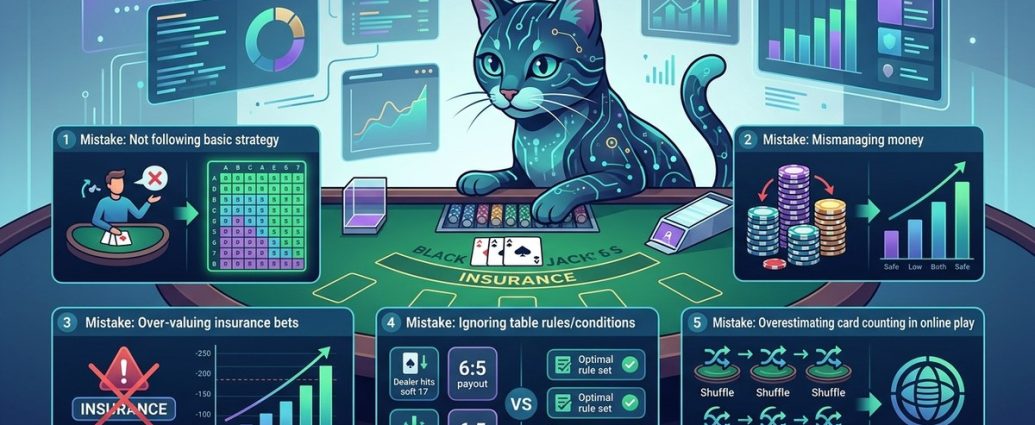
Every player at a blackjack table wants to win. But most players make the same common blackjack mistakes over and over, handing their money to the house without a fight. The worst part? Most of these errors are easy to fix. You do not need to be a math genius or a card counter. You just need to recognize where you are going wrong and make a few simple adjustments. Whether you play online or at a brick and mortar casino, these five errors might be eating into your bankroll more than you realize.
Blackjack is a game of skill and discipline. The five biggest mistakes players make are ignoring basic strategy, chasing losses with bigger bets, taking insurance, misplaying splits and doubles, and not adjusting for rule variations. Avoiding these errors can cut the house edge significantly, giving you a much better shot at walking away a winner.
Mistake #1: Playing Without a Basic Strategy Chart
Blackjack has a mathematically optimal move for every possible hand. That move is not a guess. It is based on millions of simulated hands. Yet most players rely on “gut feeling” or what they saw someone else do.
This mistake alone adds about 2% to 4% to the house edge. Over a long session, that is a huge leak.
Here is what a basic strategy chart covers:
- When to hit versus stand on hard totals (12-16 vs dealer upcard)
- When to double down (usually on 10 or 11 vs a weak dealer card)
- When to split pairs (always split Aces and 8s, never split 10s)
- When to surrender if the casino offers it (hard 16 vs dealer 10, for example)
You can find a printable chart in seconds. Use it. Do not trust your memory until you have played hundreds of hands correctly. Even then, keep the chart handy. If you want to understand the logic behind each decision, check out our guide on when to split pairs in blackjack.
Mistake #2: Ignoring Table Rules and Paytable Variations
Not all blackjack tables are the same. The rules printed on the felt affect the house edge in big ways. Many players sit down at any table without noticing key details.
Here is a table showing how different rules shift the casino advantage:
| Rule Variation | Effect on House Edge |
|---|---|
| Blackjack pays 3:2 instead of 6:5 | Reduces house edge by about 1.4% |
| Dealer stands on soft 17 (S17) vs hits (H17) | S17 is about 0.2% better for you |
| Double after split allowed | Cuts house edge by about 0.15% |
| Re-splitting Aces allowed | Another 0.1% reduction |
| Surrender available | Can lower edge by 0.07% to 0.1% |
| Single deck vs 6 or 8 decks | Single deck can be 0.5% better if rules are decent |
A 6:5 blackjack table might look identical to a 3:2 table, but it is a trap. Always check the felt. Avoid any table that says “Blackjack pays 6:5.” That rule alone pushes the house edge above 1.5%, making the game nearly impossible to beat without counting. For a broader look at how different games stack up, read our analysis of which casino games have the best odds.
Mistake #3: Chasing Losses with Bigger Bets
This is the most dangerous habit in gambling. You lose a few hands, your bankroll drops, and you think “I need to win it back fast.” So you double your next bet. Then you lose again. Now you are betting even more.
“The moment you try to recover a loss by increasing your wager, you have stopped playing blackjack and started gambling emotionally. That is when the house wins every time.” — Veteran casino dealer, Las Vegas
Chasing losses leads to ruined sessions and empty pockets. The fix is simple: set a loss limit before you sit down. When you hit it, walk away. Period. Also set a win limit. When you are up, lock in the profit.
A good approach to building a casino bankroll management system can keep you from falling into this trap. Treat your bankroll like a business. Every session is a unit of risk, not a chance to get even.
Mistake #4: Always Taking Insurance or Even Money
Insurance is a side bet that pays 2:1 when the dealer has blackjack. It is offered when the dealer shows an Ace. Many players take it automatically because they want to “protect” their hand.
But insurance is a bad bet. The dealer will have blackjack only about 30% of the time (depending on the shoe composition). That means the true odds are roughly 2.33 to 1 against you. The house edge on insurance is over 7%.
Here is a numbered list of when you should ever consider insurance:
- You are a card counter and the running count is high enough to make insurance profitable.
- That is the only scenario. Do not take it otherwise.
Even money is just insurance disguised as a guarantee. When you have a blackjack and the dealer shows an Ace, the casino offers you even money (1:1) rather than the usual 3:2. It is the same bad bet. Refuse it every time.
For more on counting techniques that do work, see how card counting still works in live dealer blackjack.
Mistake #5: Not Splitting and Doubling Down Properly
Splitting and doubling are your best opportunities to increase your expected value. But many players either do them too often or not often enough.
Common errors include:
- Splitting 10s because “two 10s are good.” They are better as one hand.
- Not splitting 8s against any dealer upcard (always split 8s).
- Doubling down on a soft 18 or 19 against a dealer 6 (bad idea; those hands already have good value).
- Not doubling down on 11 against a dealer Ace (the math says to double).
The correct plays are clear. If you are unsure, pull up a strategy chart mid-session. The dealer will let you. Other players might grumble, but that is their problem, not yours. Your money matters more than their impatience.
Practice These Fixes for Your Next Session
You do not need to memorize every rule overnight. Pick one mistake from this list and work on it during your next game. Maybe you commit to using a basic strategy chart for a full hour. Maybe you decide never to take insurance again. Small changes add up.
Blackjack is one of the few casino games where skill can tip the odds in your favor. But only if you stop making the same common blackjack mistakes that everyone else makes. Start with these five, and you will already be ahead of 90% of the players at the table.
Good luck, and play smart.