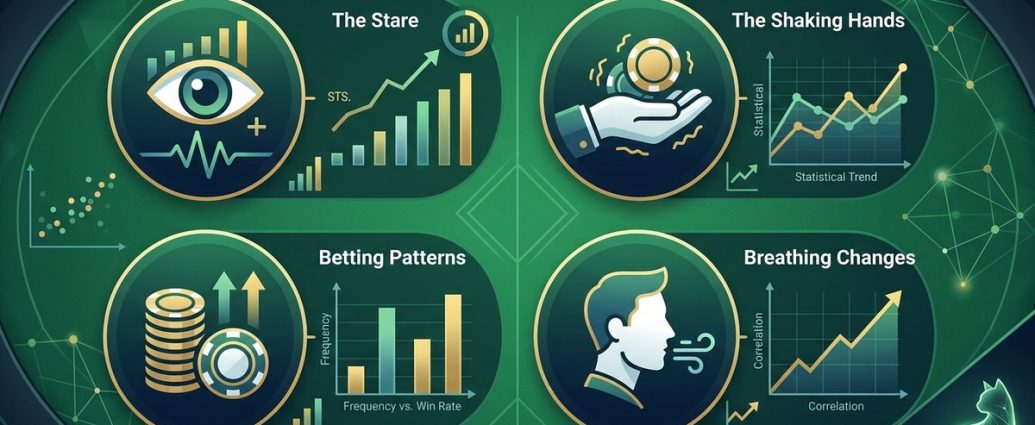
Every poker player hunts for tells. You watch your opponent’s hands, their eyes, the way they stack their chips. But here is the hard truth: most advice about common poker tells is based on stories, not data. A player looks at his cards and smiles. Does that mean he hit the nuts, or is he trying to sell you something? In this guide, we separate the signals that have real statistical significance from the noise that will drain your bankroll.
Common poker tells are tempting, but relying on the wrong ones can cost you money at the tables. This guide examines which opponent behaviors have real statistical backing and which are just noise. You will learn why timing tells, betting patterns, and baseline deviations matter more than eye contact or Hollywood acting. We provide a data-driven framework for reading opponents and spotting profitable opportunities to bluff and call. Use this evidence-based approach to level up your game in 2026.
What Makes a Tell Statistically Significant
A tell is only useful if it predicts a specific outcome more often than random chance. If a player bets fast, is he strong or weak? The answer depends on his baseline. Statistically significant tells share one thing: they involve a change in behavior from a player’s established pattern. A quiet player who starts chatting is a signal. A loud player who goes quiet is a signal. The signal is the change, not the behavior itself.
Without a baseline, any tell is just a guess. This is why beginners struggle. They look for “The One Tell” that works every time. That tell does not exist. What does exist is the ability to spot deviations in real time. That is what this guide is about.
The Tells That Data Suggests You Can Trust
Not all tells are created equal. Some have decades of behavioral research behind them. Others are just things people repeat at the table. Here are the tells that hold up under scrutiny.
Timing Tells
Data from online poker sites, which can record every mouse click, shows that timing is one of the most reliable tells available. A player who instantly calls a bet is often holding a drawing hand or a marginal made hand. A player who pauses before raising usually has a strong hand and is deciding how much to extract.
This is backed by reaction time studies. A routine action is fast. A complex decision takes longer. In a 2025 analysis of online poker timing, players who took more than 10 seconds to bet on the river had a high probability of holding a top-tier hand. When the routine breaks, pay attention. Fast action often means weakness. Slow action often means strength.
Bet Sizing and Chip Handling
How a player handles their chips can reveal their confidence. A player who throws chips forward without counting them often has a strong hand. A player who counts out his chips carefully before calling is often scared. Research into risk assessment shows that people subconsciously hesitate before committing chips with weak holdings.
This is not a perfect tell, but it is statistically significant enough to note. For context on hand strength, it helps to study Texas Hold’em starting hand rankings. Knowing which hands win most often gives you a baseline for interpreting an opponent’s confidence.
Eye Contact and Focus
The classic poker tell goes: “Strong means weak, weak means strong.” A player with shaking hands who avoids eye contact is supposed to have the nuts. But data from psychological studies on bluffing suggest this is unreliable. Some people bluff with a steady stare. Some bluff while looking at the felt.
The statistical signal here is a change in eye contact patterns. If a player has been staring you down all night and suddenly looks away when a big card hits, that is a deviation worth noting. If a quiet player suddenly starts watching you like a hawk, they are probably trying to gauge if you hit your draw. Focus on the change, not the absolute state.
Tells That Are Probably Just Noise
Just because a tell is common does not mean it is reliable. Some tells are so overused in movies and poker books that players now try to fake them. Avoid placing too much weight on these.
- Hollywood acting. Players who talk loudly or complain about bad beats are often just trying to get into your head. This is noise. It works on beginners, but experienced players ignore it.
- Physical tells like sweating or shaking. Adrenaline looks the same whether you are bluffing or holding the nuts. By the time you see physical symptoms, the information is too vague to act on profitably.
- The reverse tell. A player who is aware of tells might try to reverse them. They breathe loudly with a big hand on purpose. This meta-layer is not worth your focus until you have mastered the basics.
How to Build a Statistical Read on a Player
Reading a player is a process. It is not a single magic moment. Use this numbered list to build your reads systematically.
- Observe before you play a hand. Watch how they bet when they show down a hand. Take mental notes on their default style.
- Note their baseline. Is this player loose or tight? Passive or aggressive? Verbal or quiet? You need this to spot deviations.
- Identify deviations. Did they check their cards twice on the river? That is a deviation. Did they bet instantly on the turn after pausing on the flop? That is a pattern change.
- Test your read. Call a small bet to see their hand when you suspect a tell. Gather data without risking your stack.
- Adjust, but stay fluid. A good tell works until the opponent realizes you have caught on. Reassess every orbit.
Common Tell Hunting Mistakes
Chasing tells is fun, but it can be a distraction. Here are the most common traps players fall into.
| Technique | Common Mistake |
|---|---|
| Timing tells | Assuming fast always means weak. Baseline matters. |
| Bet sizing | Ignoring pot odds. A big bet is only a bluff if the board story makes sense. |
| Eye contact | Thinking “looking away means lying”. Some people look away as a default. |
| Table talk | Listening to the words instead of the emotion behind them. Bluffs are often chatty. |
Knowing tells is useless if you do not have a bankroll to protect your learning curve. Read our guide on building a casino bankroll management system that actually works to keep your funds safe while you practice.
“The most profitable poker tell is not a stare or a sigh. It is a change in the pattern. A player who usually bets fast and suddenly pauses has something to think about. That pause is worth money.”
Putting the Evidence into Practice
The goal is not to turn into a mind reader. The goal is to tilt the odds in your favor by a few percentage points. Using the most common poker tells without statistical backing is a gamble in itself. By focusing on deviations, timing, and bet patterns, you make decisions based on signals that actually mean something. Your bankroll will thank you.
Now, try this at the tables. Pick one player. Ignore the Hollywood acting. Just watch their timing and their baseline. You will start seeing patterns immediately. Then, read our guide on reading poker opponents in online cash games without physical tells to sharpen your digital game. Every hand deals a new piece of data. Start collecting it today.