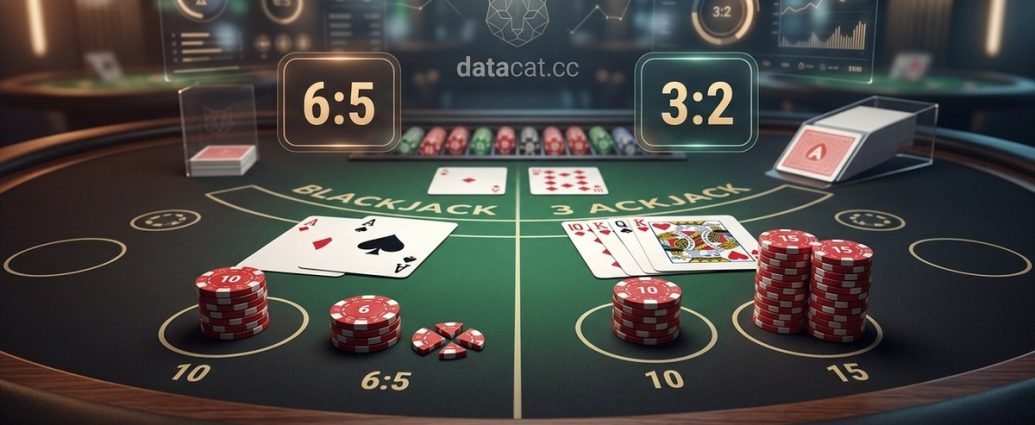
You walk through a casino floor in 2026 and spot a blackjack table with a tempting sign. Minimum bet is only $5. The table is nearly full, players are laughing, and the dealer is friendly. But then you notice the small print: “Blackjack pays 6 to 5.” That tiny change is one of the most dangerous traps in modern gambling. It turns a classic player-friendly game into a losing proposition that can drain your bankroll faster than almost any other table game. And yet, thousands of players sit down every day, lured by the low stakes and the familiar green felt. They do not realize they are playing a completely different game.
6:5 blackjack pays $6 for every $5 bet on a natural blackjack, instead of the traditional $7.50. That seemingly small difference increases the house edge by about 1.4%, turning an already tough game into a losing disaster. Even perfect basic strategy cannot overcome this. Never sit at a 6:5 table, no matter how low the minimum bet looks. Your bankroll will last much longer playing 3:2 blackjack elsewhere.
What Is 6:5 Blackjack
Blackjack has always been famous for one special payout: a natural blackjack (an Ace plus a ten-value card on the first two cards) pays 3 to 2. That means if you bet $10 and get a blackjack, you win $15. That extra $5 over your original bet is a big reason why the game has a low house edge when played with basic strategy.
In 6:5 blackjack, a natural blackjack pays only $12 for a $10 bet. You lose $3 every time you get a blackjack compared to the traditional version. That three dollar difference does not seem huge on a single hand, but blackjacks happen roughly once every 21 hands. Over a few hours, the lost money adds up quickly.
Casinos introduced 6:5 payouts around the early 2000s as a way to keep blackjack tables profitable while offering lower minimum bets. They knew players would see the low limit and ignore the changed payout. Today, 6:5 tables dominate many casino floors, especially in Las Vegas and on cruise ships. They are everywhere, and they are designed to separate you from your money.
The Math Behind the Disaster
Let us break down the numbers with a simple comparison. Imagine you play 100 hands of blackjack. Statistically, you will get a blackjack about 4.7 times in those 100 hands. Here is what each of those blackjacks pays on a $10 bet:
| Payout Type | Payout per Blackjack | Total for 4.7 Blackjacks | Difference from 3:2 |
|---|---|---|---|
| 3:2 | $15.00 | $70.50 | baseline |
| 6:5 | $12.00 | $56.40 | -$14.10 |
On a $25 bet, the difference grows even larger. Those 4.7 blackjacks would pay $176.25 with 3:2, but only $141.00 with 6:5. That is $35.25 less. Over a full session of 200 hands, you lose $70 or more just from the blackjack payout difference. And that is before considering the house edge on all other hands.
The house edge for standard 3:2 blackjack with good rules (dealer stands on soft 17, double after split allowed, etc.) is around 0.5% when using basic strategy. Switch to 6:5 blackjack, and that house edge shoots up to about 1.9% to 2.0%. That is nearly four times higher. You are essentially playing a game with odds worse than most slot machines.
“6:5 blackjack is the biggest scam in the casino,” says veteran player and author John Grochowski. “It takes a game that gives you a fair fight and turns it into a tax on anyone who does not read the fine print. I have seen players lose hundreds of dollars in an hour simply because they did not realize the payout had changed.”
How 6:5 Blackjack Increases the House Edge
The increase in house edge does not come from one place alone. It is the result of several rule changes that often accompany 6:5 tables. Here are the most common ways casinos make 6:5 even worse:
- No surrender option: Most 6:5 tables do not allow you to surrender a bad hand. That removes a key player advantage.
- Dealer hits soft 17: Many 6:5 games force the dealer to hit on soft 17, which adds another 0.2% to the house edge.
- Limited doubling rules: Some 6:5 tables only allow doubling on 10 or 11, not on any total.
- No re-splitting aces: If you split aces and get another ace, you cannot split again.
- Blackjack pays even money on split hands: After splitting, a natural 21 is paid 1:1, not 3:2 or 6:5.
These rule changes stack on top of the reduced blackjack payout. A table that advertises “6:5 Blackjack” often has all these extra disadvantages baked in. You are not just losing the 3:2 payout. You are playing a fundamentally different, far more brutal game.
Why Casinos Push 6:5 Tables (And Why You Should Resist)
Casinos love 6:5 blackjack for one simple reason: it makes them more money with less risk. The lower minimum bets attract casual players who might not otherwise sit at a table. These players are less likely to know the difference between 6:5 and 3:2. They see a $5 table and jump in without reading the rules.
The casino also likes 6:5 because it discourages skilled players. Card counters and advantage players avoid 6:5 like the plague. The increased house edge makes counting almost pointless. So the table becomes filled with recreational players who make basic strategy mistakes, further boosting casino profits.
In 2026, some casinos have even started offering 6:5 on all single-deck and double-deck games. Single-deck blackjack used to be the holy grail for players because it offered the lowest house edge. Now many single-deck tables pay 6:5, completely destroying that advantage.
If you ever see a single-deck or double-deck table with a low minimum bet, check the payout before sitting down. If it says 6:5, walk away. The casino is using the illusion of better odds to trap you.
The Hidden Costs You Might Overlook
Beyond the math, 6:5 blackjack creates psychological and strategic problems. Here are some hidden costs that even experienced players sometimes miss:
-
You lose the power of insurance. When the dealer shows an Ace, you can buy insurance against a blackjack. In a 3:2 game, insurance is a break-even bet if you count cards. In 6:5, the payout on a dealer blackjack is also 6:5, so insurance becomes even worse. You should rarely take insurance anyway, but 6:5 makes it a guaranteed loser.
-
Your basic strategy changes slightly. Some basic strategy decisions, like when to stand on 16 against a dealer 10, shift because the reduced payout alters the risk-reward calculation. Most players do not adjust, so they make more mistakes.
-
You earn fewer comps and rewards. Casinos often rate players based on their theoretical loss. Because the house edge is higher on 6:5, they rate you as a higher loss player. But the actual comps you receive are usually based on your average bet and time, not the house edge. So you end up losing more and getting the same comps as a 3:2 player.
-
You cannot use standard strategy cards. Many strategy cards and phone apps assume a 3:2 payout. If you use them at a 6:5 table, you will make suboptimal decisions on close calls like splitting tens or doubling against certain dealer upcards.
For a deeper look at how basic strategy changes in different situations, read our guide on when to split pairs in blackjack. It covers the math behind pair splitting and why 6:5 changes the odds.
How to Spot a 6:5 Table (And Walk Away)
Identifying a 6:5 blackjack table is easy once you know what to look for. Follow these three steps before you sit down:
-
Read the table felt or signage. Most casinos print the payout clearly on the felt near the betting circle. Look for “Blackjack pays 6:5” or “BJ pays 6:5.” Some casinos use smaller text, so lean in close. If you cannot find it, ask the dealer.
-
Ask the dealer directly. Say, “What does blackjack pay here?” A good dealer will answer honestly. If they say “6 to 5” or “6 for 5,” thank them and move on. Do not feel pressured to play because you asked.
-
Watch a few hands before sitting. If you see a player get a blackjack and receive $12 for a $10 bet, that is a 6:5 table. The dealer will often announce the payout verbally. Use that information to decide.
If the table is 3:2, the dealer will usually say “Blackjack pays three to two” or you will see $15 paid on a $10 bet.
Remember, the temptation to sit at a low-limit 6:5 table is real. The minimum might be $5 while the nearest 3:2 table is $25. You might think, “I will just play a few hands and leave early.” But the math is against you. You will lose money faster per dollar wagered on the 6:5 table than on a $25 3:2 table. It is better to wait for a seat at a 3:2 table or play a different game entirely.
If you want to learn which games offer the best odds overall, check out our article on which casino games have the best odds. It ranks table games by their house edge and shows you where your money goes furthest.
Better Blackjack Options in 2026
You do not have to give up blackjack. You just need to find the right version of it. Here are the best alternatives to 6:5 blackjack in 2026:
-
3:2 standard multiple-deck games – Look for 6-deck or 8-deck shoes that pay 3:2. Many casinos still offer them, though often at higher minimum bets. The house edge with basic strategy is around 0.5% to 0.8%.
-
Live dealer online blackjack – Online casinos offer live dealer blackjack with 3:2 payouts and lower minimums than land-based casinos. You can play from home and avoid the smoke-filled rooms. Check our guide to live dealer games for a comparison.
-
Single-deck or double-deck with 3:2 – These are rare but still exist, especially in higher-limit rooms. If you find one, the house edge can be as low as 0.2% with perfect strategy.
-
Blackjack with player-friendly rules – Look for tables that allow surrender, dealer stands on soft 17, double on any two cards, and re-splitting aces. These little advantages add up.
For a complete list of the most common blackjack mistakes, read the 5 biggest mistakes blackjack players make. It will help you avoid pitfalls even at good tables.
If you prefer online play, many reputable sites let you filter by payout rules. You can sort tables to show only 3:2 games. Some even have a “European” or “Classic” blackjack variant that pays 3:2. Avoid any variant labeled “Blackjack Switch” or “Free Bet Blackjack” unless you understand their different payout structures. They are not traditional blackjack and often have hidden traps.
Your Bankroll Deserves Better
6:5 blackjack is not just a bad deal. It is a calculated move by casinos to exploit casual players. The low minimum bet acts as bait, and the payout change is the hook. Once you understand the math, the choice becomes clear.
Every time you pass a 6:5 table, remind yourself that you are leaving money on the felt. The $3 you lose on each blackjack might seem small, but over a year of regular play, it can add up to hundreds or even thousands of dollars. That money could buy you a nice meal, a new gadget, or a weekend trip.
The smartest move is to always check the payout before you sit. If you cannot find a 3:2 table within your budget, consider playing a different game altogether. Baccarat, craps, or even video poker can offer better value. You are not missing out by skipping 6:5 blackjack. You are protecting your bankroll and playing with your eyes open.
Next time you are in a casino, use what you have learned. Look for the payout. Ask the dealer. And if all you see is 6:5, smile, turn around, and find a better game. Your wallet will thank you.