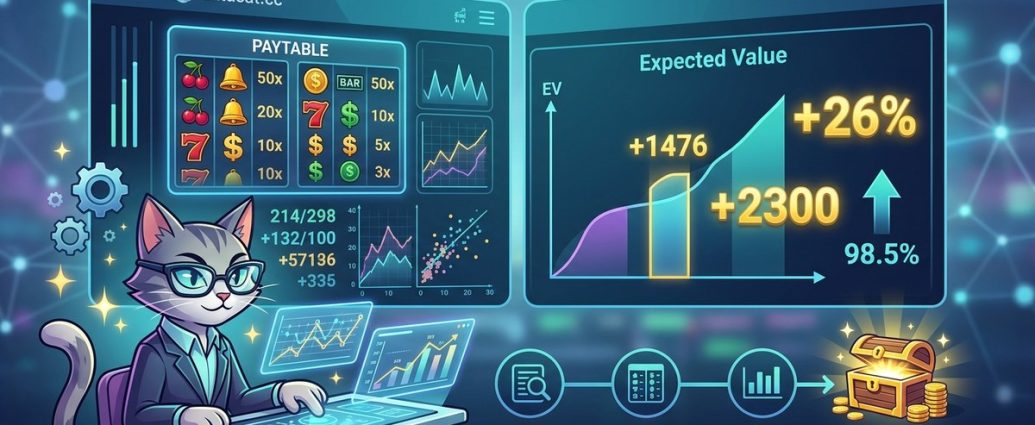
Most players sit down at a slot machine, glance at the flashy symbols, and start spinning without a second thought. They have no idea what the game actually pays for each combination. That is a expensive habit. The truth is, the paytable is the single most important document in any slot game. It tells you exactly how the math works behind the reels. If you learn how to read it properly, you can stop guessing and start making informed decisions about where your money goes.
Analyzing a slot paytable is the only reliable way to estimate a game’s expected value before you play. Focus on three core metrics: the return to player percentage, the hit frequency, and the pay multiplier for top combinations. Compare these numbers across multiple games. Avoid slots where low-paying symbols cluster at tiny multipliers and where bonus triggers require rare scatter hits. The best games balance moderate top prizes with frequent small wins.
What a Paytable Actually Tells You
A paytable is not just a list of pretty pictures. It is a mathematical contract between you and the game. Every slot has one, and every reputable online casino makes it accessible with one tap or click.
The paytable shows:
- Which symbols pay what amount
- How many matching symbols you need on a payline to win
- What wilds and scatters do
- How bonus rounds trigger
- The maximum potential payout
But here is the catch. Many paytables hide the most important number: the theoretical return to player (RTP). Some games display it openly. Others bury it in the help menu or the game rules. Always find it.
Why Most Players Read Paytables Wrong
Casual players look at a paytable and think, “Oh, the top jackpot is 5,000x my bet. This must be a good game.” That is a trap. A massive top prize often comes with a tiny probability of hitting it. Meanwhile, the base game might pay back only 70% of your wagers.
The real question is not “how much can I win?” It is “how often will I win something, and how much will those wins average out to?”
This is where expected value (EV) comes in. EV tells you the average return per spin over a long session. You cannot know the exact EV without the game’s full math model, but you can estimate it by reading the paytable correctly.
A Step-by-Step Process for Analyzing Any Slot Paytable
Here is the practical method I use when I want to evaluate a slot before playing.
-
Open the paytable and find the RTP. Look for a line that says “Return to Player” or “Theoretical RTP.” If the game does not show it, search for the game’s help file or check the casino’s game info page. Any RTP below 95% is a hard pass for me. In 2026, many top online slots offer 96% to 98% RTP. Do not settle for less.
-
Identify the lowest paying symbols. Most slots have a tier of low symbols (often 9, 10, J, Q, K, A) that pay 2x to 5x your bet for five of a kind. Note the multiplier. If five identical low symbols pay only 2x, that is weak. Look for games where five low symbols pay 4x or higher.
-
Check the medium and high symbol values. High symbols (themes like gems, characters, or animals) should pay 10x to 50x for five of a kind. If the gap between low and high symbols is too narrow, the game will feel flat. If the gap is too wide, the game may be volatile and drain your bankroll between big hits.
-
Count the number of ways to trigger the bonus. Most slots require three or more scatter symbols to start free spins. If the scatter appears only on certain reels, that lowers your chance. Ideally, scatters should appear on all reels.
-
Estimate the hit frequency. Hit frequency is the percentage of spins that result in any win. You can often find this in the game details. A hit frequency below 20% means you will lose most spins. Above 30% is comfortable for extended play.
Key Metrics to Compare Across Games
When you are shopping for a slot, use this table to compare the critical numbers.
| Metric | What It Means | Good Range | Red Flag |
|---|---|---|---|
| RTP | Theoretical return over millions of spins | 96% or higher | Below 94% |
| Hit frequency | % of spins that pay anything | 25% to 40% | Below 20% |
| Top symbol payout (5 of a kind) | Multiplier for the highest regular symbol | 20x to 100x | Below 10x |
| Scatter frequency | How often bonus triggers | Every 80 to 150 spins | Every 200+ spins |
| Bonus retrigger possible? | Can you extend free spins? | Yes | No |
Use this table as a filter. If a game fails on two or more metrics, move on.
Common Mistakes That Cost You Money
Even experienced players make errors when reading paytables. Here are the biggest ones.
-
Ignoring the payline configuration. A 20-payline game with low symbol values is worse than a 50-payline game with similar values, because you have fewer ways to win. But more paylines also means higher total bet. Always compare the paytable relative to your total wager.
-
Falling for “per way” vs “per line” confusion. Some slots pay per payline, others pay per “way” (any position on adjacent reels). A 243-ways slot can feel generous, but the symbol multipliers may be lower to compensate. Do the math for a typical win.
-
Assuming all scatters are equal. Some games require three scatters on consecutive reels (left to right). Others allow them anywhere. Read the fine print.
-
Overlooking the smallest wins. A game that pays 1x your bet for three low symbols is giving you almost nothing back. Over time, those tiny wins add up, but they also drain your bankroll if they are too rare.
Expert advice: The best slots for value are not the ones with the biggest jackpots. They are the ones with the most favorable distribution of small, medium, and large wins. A game that pays 96% RTP with a 30% hit frequency will keep you playing longer and losing slower than a game with 96% RTP and a 15% hit frequency, even if the latter has a higher top prize.
What to Look for in Bonus Buy Games
Some modern slots let you buy direct access to the bonus round for a fixed cost. This changes how you analyze the paytable.
If a game has a bonus buy option, calculate the cost relative to the average bonus payout. This is called the “bonus buy value.” You can often find community data on expected return for bonus buys.
For example, if buying the bonus costs 100x your bet and the average bonus returns 80x, that is a losing proposition. But if the average bonus returns 120x, the buy is positive EV. Some slots, like those from certain studios in 2026, are designed specifically around bonus buys. Always check the paytable for the bonus round’s potential before spending real money.
Red Flags to Spot in a Paytable
Not all paytables are created equal. Some are designed to look better than they really are. Watch for these signs.
- The RTP is listed only in the game rules, not in the paytable itself
- Low symbol payouts are 1x or 2x for five of a kind
- Scatter symbols appear only on reel 1 and reel 5
- The bonus round has no retrigger possibility
- The top jackpot requires a specific combination that is mathematically nearly impossible
- The paytable text is vague about probabilities
If you see any of these, treat the game with caution.
How to Practice Paytable Analysis Without Risk
Before you deposit real money, you can practice analyzing paytables on free demo versions. Every reputable online casino offers demo play for slots. Use these steps.
- Pick five different slots from different providers (NetEnt, Playtech, Pragmatic Play, etc.)
- Open each paytable and write down the RTP, hit frequency (if listed), low symbol payout, high symbol payout, and scatter rules
- Compare your notes against the table above
- Play 100 free spins on each and track how often you win versus what the paytable predicted
This exercise will train your eye to spot good value games. Over time, you will learn which game studios consistently offer favorable paytables.
If you want to go deeper, consider reading our guide on how to calculate true slot RTP using your own session data. That will help you verify whether a game’s real performance matches its advertised numbers.
Putting It All Together in Your Game Selection Routine
Here is a checklist you can run through every time you consider a new slot.
- Is the RTP above 96%?
- Do five low symbols pay at least 4x my bet?
- Do five high symbols pay at least 20x my bet?
- Does the bonus trigger from any reel?
- Can the bonus round retrigger?
- Is the hit frequency above 25%?
- Is the top jackpot reasonable for the volatility level?
If a game passes all seven checks, it is worth your time. If it fails three or more, skip it. There are hundreds of slots available in 2026. You do not need to play the bad ones.
Your Paytable Analysis Starts Now
The difference between a casual slot player and a smart one comes down to one habit: reading the paytable before you spin. It takes less than two minutes, and it can save you from games designed to drain your bankroll fast. Start using the method in this article today. Pick a game you have never tried, open its paytable, and run through the checklist. You will be surprised how many popular slots fail the test. And when you find one that passes, you will know exactly why it is worth your money.