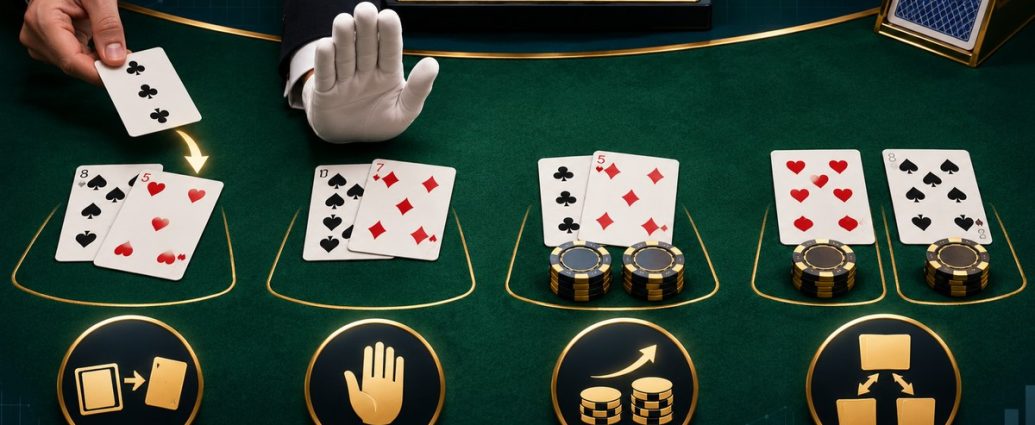
You sit down at a blackjack table, the felt is green, the cards are sliding, and the dealer flashes a 6. Your hand shows a 12. What do you do? Most players guess. They hope. But guessing is exactly what the casino wants you to do. There is a right answer for every hand in blackjack, and it has been mathematically proven for decades. That answer lives inside the blackjack basic strategy chart. This chart is not a secret system or a counting trick. It is simply the best possible move for every situation, calculated from millions of simulated hands. Once you learn to read it, you stop playing on instinct and start playing with the odds.
A blackjack basic strategy chart tells you the single best move for every possible hand against every dealer up card. It reduces the house edge to under 0.5% in most games. You do not need to memorize every cell. Focus on the most common hands: hard totals between 12 and 16, soft 17 and 18, and when to split 8s and Aces. Print the chart and keep it at the table until the moves become automatic.
How to Read the Blackjack Basic Strategy Chart
The chart is organized into three sections. Each section covers a different type of hand you can hold. Your decision depends on your total and the dealer’s face-up card.
Hard hands are totals that do not contain an Ace, or totals where an Ace must count as 1 to avoid busting. For example, a 10 and a 7 make a hard 17. A 5, 4, and 3 also make a hard 12.
Soft hands contain an Ace that counts as 11. If you have an Ace and a 6, you have a soft 17. The “soft” part means you can take another card without busting, because the Ace can drop to 1.
Pairs are when your first two cards match. A pair of 8s, a pair of 4s, or a pair of Aces are the most common splitting decisions.
The dealer’s up card is the number you see face-up in front of the dealer. That card drives your decision. A dealer showing a 5 is much weaker than a dealer showing a 10.
Here is a simple breakdown of the three hand types and the general rule for each.
| Hand Type | Definition | General Strategy |
|---|---|---|
| Hard Hand (12-16) | No Ace, or Ace as 1 | Stand against dealer 2-6, hit against 7-Ace |
| Hard Hand (17+) | No Ace, or Ace as 1 | Always stand |
| Soft Hand (13-17) | Ace counts as 11 | Hit until you reach soft 18 or hard 17 |
| Soft Hand (18) | Ace counts as 11 | Stand against dealer 2-8, hit against 9-Ace |
| Pairs (8s, Aces) | Two matching cards | Always split 8s and Aces against any dealer card |
The Three Moves You Will Use Most Often
Most of your decisions at the table will be hit or stand. Doubling down and splitting happen less often, but they are powerful when used correctly.
Hit means you take one more card. You should hit when your hand is weak and the dealer has a strong up card. For example, a hard 12 against a dealer 2 is a hit. A hard 16 against a dealer 10 is also a hit.
Stand means you keep your current total. You stand when your hand is strong enough to beat the dealer’s likely final total. Hard 17 always stands. Soft 18 stands against a dealer 2 through 8.
Double down means you double your bet and receive exactly one more card. You only double when the odds are heavily in your favor. A hard 11 against any dealer card is a double. A soft 16 against a dealer 4 is also a double.
Split means you separate two matching cards into two separate hands, each with its own bet. You always split Aces and 8s. You never split 10s, 5s, or 4s (with one exception for 4s against a dealer 5 or 6).
A Step-by-Step Process for Every Hand
Follow these steps in order. Do not skip ahead. The order matters because some hands fit multiple categories.
-
Check for blackjack first. If you have an Ace and a 10-value card, you already won (unless the dealer also has blackjack). Do not overthink this.
-
Check for a pair. If your two cards match, look at the pair section of the chart. Split Aces and 8s every time. Split 2s, 3s, 6s, and 7s only against certain dealer cards. Never split 10s, 5s, or 4s (except 4s against dealer 5 or 6).
-
Check for a soft hand. If you have an Ace that counts as 11, use the soft hand rules. Soft 17 and below always hit. Soft 18 stands against dealer 2 through 8. Soft 19 and above always stand.
-
Check for a hard hand. If your hand is hard and between 12 and 16, stand against dealer 2 through 6. Hit against dealer 7 through Ace. Hard 17 and above always stand. Hard 11 and below always hit.
-
Double down when the chart says so. If you have a hard 9, 10, or 11, or a soft 13 through 17, check the dealer card. Double against weak dealer cards. Do not double against a dealer Ace or 10.
Expert advice: Do not let the dealer or other players rush you. You have every right to check your chart between hands. The casino floor might feel fast, but your decision is yours alone. Take the three seconds you need.
Common Mistakes Players Make
Even players who know the chart exists still make errors under pressure. Here are the most common ones.
-
Standing on a soft 18 against a dealer 9 or 10. This is a mistake. Soft 18 is strong, but a dealer 9 or 10 has a high chance of making 19 or 20. You must hit soft 18 against a dealer 9, 10, or Ace.
-
Splitting 10s. A pair of 10s gives you 20. That is a very strong hand. Splitting it gives you two hands starting at 10, which is much weaker. Never split 10s.
-
Doubling down on a hard 8 against a dealer 6. The chart says to hit, not double. Hard 8 is not strong enough to double against any dealer card. Wait for hard 9, 10, or 11.
-
Forgetting to double on soft 16 against a dealer 4. Soft 16 is a great doubling opportunity. Many players hit instead of double, leaving money on the table.
-
Hitting a hard 12 against a dealer 4. Hard 12 is weak, but a dealer 4 is also weak. The math says stand. Hitting gives the dealer a better chance to win.
Why the Chart Works (And When It Doesn’t)
The blackjack basic strategy chart assumes a standard set of rules. The most common rules in US casinos are a 6-deck shoe, the dealer hits on soft 17, and you cannot surrender. Under those rules, the house edge is about 0.5% when you play perfectly. That means for every $100 you bet, you expect to lose about 50 cents over the long run.
If the dealer stands on soft 17, the house edge drops even lower. If the game pays 6 to 5 on blackjack instead of 3 to 2, the house edge jumps to over 1.4%. You should avoid 6 to 5 blackjack tables entirely. They are becoming more common on the Las Vegas Strip, but they are a terrible deal for players.
The chart does not work for single-deck games with different rules. It also does not account for card counting. If you are counting cards, the basic strategy is your starting point, but you will deviate based on the remaining deck composition. For most casual players, the standard chart is all you need.
How to Practice Without Losing Money
You do not need to risk real money to learn the chart. Use these methods to build muscle memory.
-
Play free online blackjack games. Many sites offer practice mode where you can play without a deposit. Keep the chart open in another window. Check every hand.
-
Use a blackjack trainer app. These apps deal hands and ask you to make a decision. They tell you instantly if you got it right. Most trainers track your accuracy over time.
-
Deal cards to yourself at home. Shuffle a deck and deal two cards to yourself and one to the dealer. Look up the correct move on the chart. Repeat for 100 hands.
-
Focus on the most common hands first. You will see hard 12 through hard 16 more than any other hands. Master those. Then learn soft 17 and soft 18. Then learn the split decisions.
Putting the Chart Into Real-World Play
When you sit down at a real table, the game moves faster than practice. Do not panic. Keep a printed copy of the blackjack basic strategy chart in your pocket or on your phone. Casinos allow paper charts at the table. Just unfold it and look.
If you are playing online, bookmark the chart in a separate browser tab. Most online casinos do not restrict reference materials. You are not counting cards. You are simply making optimal decisions based on the cards you see.
Remember that the chart assumes you are playing for the long run. You will lose hands you expect to win. You will win hands you expect to lose. That is normal. The chart does not guarantee a win on any single hand. It guarantees that over thousands of hands, you lose less than almost anyone else at the table.
Your First Session With the Chart
Here is how to approach your first real session using the chart.
-
Start at a low-stakes table. Look for tables with a $5 or $10 minimum bet. You want to focus on the decisions, not the money.
-
Play slowly. Announce your move clearly to the dealer. If you need to check the chart, take your time. Other players might sigh, but you are playing your hand, not theirs.
-
Ignore side bets. Do not play the insurance or “bust it” side bets. They have a high house edge and are not part of basic strategy.
-
Track your results. After 50 hands, check how often you made the correct move. If you made mistakes, review those hands. Most mistakes happen on soft 18 and hard 12 against a dealer 2.
-
Adjust for rule changes. If the dealer stands on soft 17, the chart changes slightly. If the game uses 8 decks instead of 6, the chart stays the same. Always confirm the rules before you sit down.
Taking Your Blackjack Game Further
Once you have the basic strategy chart memorized, you might want to learn more about the math behind the decisions. Understanding why the chart works helps you trust it even when your gut says something else.
If you are interested in the deeper strategy, read our guide on when to split pairs in blackjack. It covers the specific math behind every split decision. You can also check out the 5 biggest mistakes blackjack players make to see where most beginners go wrong.
For players who want to understand the house edge across different games, our breakdown of which casino games have the best odds puts blackjack in context against other table games.
Making the Chart Your New Habit
Learning the blackjack basic strategy chart is like learning the rules of the road. At first you check every sign. After a while, the moves become automatic. You see a dealer 6 and your hand is 14, and you know to stand before you even finish thinking about it. That is the goal.
Print the chart. Keep it with you. Use it every time you play. The house edge in blackjack is already small. With the chart, you shrink it to almost nothing. That is the closest thing to a fair fight the casino offers. Take advantage of it.
The next time you sit down at a blackjack table, you will not be guessing. You will know exactly what to do. And that knowledge is worth more than any lucky streak.