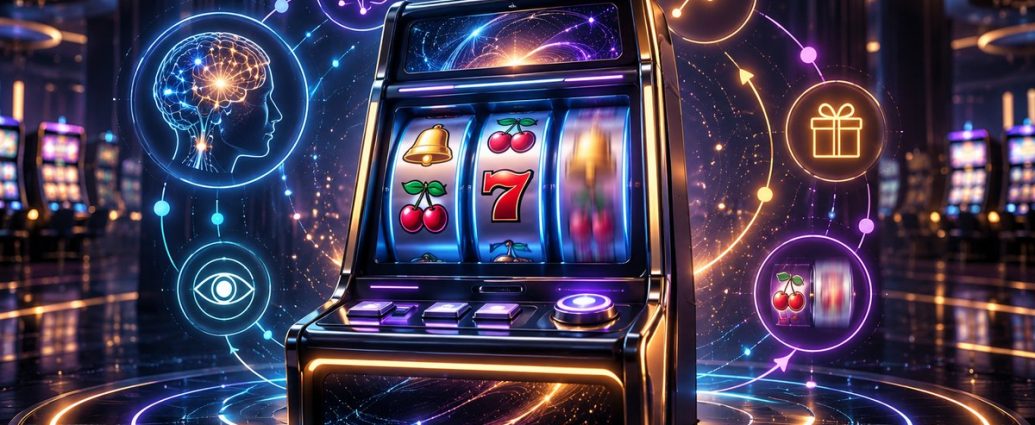
Slot machines are the undisputed kings of the casino floor. They generate more revenue for casinos than blackjack, roulette, and craps combined. But the real story isn’t about luck. It’s about how these machines are built to hack your brain. Every sound, every flash of light, and every near-miss is a carefully tested psychological trigger designed to keep you feeding the machine. Once you see these tricks, you can’t unsee them. And that knowledge is your best defense.
Slot machines are engineered around a single principle: variable ratio reinforcement. This unpredictable reward system floods your brain with dopamine, making each spin feel like a potential win. Designers add near-misses, sensory feedback, and the illusion of control to keep you playing. Understanding these tricks helps you spot manipulation and set healthy boundaries before you spin.
The Brain Hack Behind Every Spin
The foundation of slot machine psychology rests on a discovery made by psychologist B.F. Skinner in the 1950s. Skinner built a box where a pigeon would receive a food pellet at random intervals after pecking a lever. The pigeons pecked constantly, convinced the next peck could be the one that paid off. Slot machines work the same way. You pull the lever, and sometimes you win. The unpredictability is the hook.
This is called variable ratio reinforcement. It is the most powerful behavioral conditioning tool ever discovered. When a reward is guaranteed, your brain gets bored. When a reward is random, your brain releases dopamine in anticipation of the reward, not just after you get it. That anticipation is what makes you want to spin again.
How Sound and Visuals Wire Your Brain
Slot machines are sensory assault weapons, and every element is tuned for maximum effect.
Sound design is the first layer. Winning sounds are high pitched and layered with chimes. Even a small win triggers a cascade of audio that sounds like a major event. Losing spins are silent or produce a dull thud. This contrast makes losses fade from memory while wins feel huge. Casinos also pump ambient noise into the floor to mask the sound of silence, keeping the energy high.
Visual tricks are just as deliberate. The reels spin fast, but they slow down just before stopping. This creates a moment of suspense. The symbols on the reels are also carefully chosen. Bright colors like red and gold signal excitement. The classic 7 is red because it stands out. When you almost land a jackpot, the screen fills with celebratory animations anyway. Your brain gets a mini reward even though you lost money.
The speed of play matters too. Modern digital slots can cycle a spin in under three seconds. The faster you play, the more decisions you make on autopilot. Your rational brain checks out, and your emotional brain takes over.
Losses Disguised as Wins: The Sneakiest Trick
One of the most effective design patterns is the “loss disguised as a win.” You bet $1. The reels spin and land on two cherries and a bar. The machine plays a cheerful jingle, flashes “WINNER” on the screen, and credits you $0.20. You feel good. You just won something. But you actually lost $0.80.
Research shows that players significantly underestimate how much they lose when these small “wins” keep coming. The machine conditions you to associate the sound and lights with success, even when your bankroll is shrinking. This technique is so effective that many modern slot games are built around it.
Near-Misses: Almost Winning Feels Like Winning
Near-misses are the most dangerous tool in the designer’s kit. A near-miss is when the reels show two jackpot symbols and the third symbol stops one position away. Your brain processes this as “so close” and releases dopamine almost as strongly as a real win.
Here is the problem: near-misses do not happen by chance. The random number generator inside the machine does not decide where the reels stop visually. The game knows the outcome before the reels start spinning. The visual near-miss is an illusion programmed to appear more often than natural probability would allow. The machine is lying to you about how close you came.
To understand how this compares to other casino games, check out our guide on which casino games have the best odds.
The Illusion of Control
Slot machines give you buttons to press. You can stop each reel individually. You can choose your bet size. You can select which paylines to activate. All of these options make you feel like a skilled player. None of them affect the outcome.
Psychologists call this the illusion of control. When players can press a “stop” button, they report feeling more in control. They play longer. They bet more. But the result is the same as if the machine stopped on its own. The button is a prop. It exists only to keep your brain engaged.
Here are the most common control illusions in slot design:
- A “stop” button for each reel
- A “hold” feature that freezes certain symbols
- A “bonus” round that requires a button press
- A “skill stop” mini-game during free spins
None of these change the house edge. They just make you feel like you almost had a say in the outcome.
The Dark Flow State
Have you ever sat at a slot machine and lost track of time completely? That feeling is called “dark flow.” It is a trance-like state where your sense of self and time dissolves. You are just spinning, watching, and reacting.
Dark flow happens because slots require just enough attention to keep you engaged but not enough to tire your brain. You do not need to make complex decisions like in poker. You do not need to count cards. You just press a button and watch. This low cognitive load lets you enter a rhythm. And when you are in that rhythm, it is very hard to stop.
A 2023 study on reward reactivity and dark flow found that players who experienced stronger dark flow also reported higher enjoyment, even when they were losing money. The machine is not just taking your money. It is giving you an escape from your thoughts.
The Mathematics of the Trap
Casinos do not rely on psychology alone. They rely on math. Every slot machine has a programmed house edge, usually between 5% and 15%. That means for every $100 you bet, the machine keeps $5 to $15 on average. Over time, you will lose.
But the math is hidden behind psychology. The house edge is invisible in the short term. You might win $50 on your first ten spins. That win is real, but it is a statistical anomaly. It is also the hook. That early win creates a memory that overrides the long-term loss.
| Design Tactic | What It Does | Why It Works |
|---|---|---|
| Variable rewards | Releases dopamine in anticipation | Random wins are more exciting than predictable ones |
| Near-miss frequency | Feels like “almost winning” | Brain treats near-miss similar to a win |
| Loss disguised as win | Small payouts feel like success | You ignore the net loss |
| Illusion of control | Buttons and choices feel meaningful | You blame yourself, not the machine |
| Sensory overload | Sound and lights amplify emotion | Rational thinking is drowned out |
How to Use This Knowledge to Play Smarter
Knowing how the machine works does not make you immune to its effects. But it does give you tools to protect yourself.
- Set a loss limit before you sit down. Decide exactly how much you are willing to lose. When you hit that number, walk away. Do not chase losses.
- Use a timer. Slots warp your sense of time. Set an alarm for 30 minutes. When it goes off, stand up and leave the machine. Take a break.
- Bet the minimum. The house edge applies to every spin. Betting small reduces the speed of your losses and gives you more playtime for your money.
- Ignore the sounds and lights. Cover the screen or play with the volume off. The sensory feedback is designed to trick you. Without it, the game feels different.
- Count your “wins” as losses. Every time you get a payout that is less than your bet, mentally mark it as a loss. This rewires your perception of the loss disguised as win.
For a deeper look at how to manage your bankroll, read our guide on how to build a casino bankroll management system that actually works.
“The house edge is not a secret. The psychology is. Once you see the near-miss for what it is, you can choose to stop spinning.” – Dr. Natasha Dow Schull, anthropologist and author of Addiction by Design
The Slot Machine’s Real Revenue Source
Most players think jackpots are where the money comes from. They are wrong. Slot machines make the vast majority of their revenue from small, frequent losses. The player who sits down with $20 and plays for an hour is more profitable than the high roller who wins a $10,000 jackpot once a year.
This is why machines are designed to keep you spinning at a low bet level. The longer you play, the more the house edge compounds. The machine does not need to win every spin. It only needs to win over time. And time is on its side.
If you want to see how this compares to other games, take a look at our breakdown of the math behind the house edge.
Turning the Mirror on the Machine
The psychology of slot machine design is not a secret conspiracy. It is a well-documented science. Casinos have spent decades refining every element of the experience to maximize time on device. The lights, the sounds, the near-misses, and the variable rewards are all part of a system designed to override your rational brain.
But here is the good news. Once you understand the system, you can choose how to interact with it. You can set boundaries. You can play for entertainment, not for profit. You can walk away when the fun stops. The machine has no power over you that you do not give it.
Next time you sit down at a slot machine, pay attention to how it makes you feel. Notice the near-miss. Notice the sound of a small win. Notice the urge to spin again. And then decide if you want to keep playing or if you are ready to walk away. That awareness is the only real edge a player can have.
For more on choosing games that fit your goals, see our guide on how to choose the right casino game for your playing style.