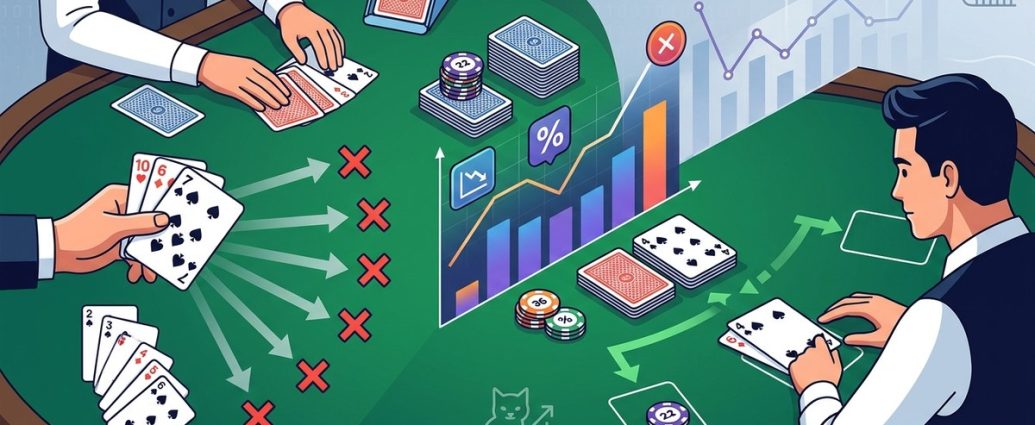
You sit down at a blackjack table, and within a few hands, you see it happen. The dealer flips over a six, then a ten, and reaches for another card. The next card is a seven. Bust. The dealer just went over 21. It feels almost routine. You might wonder if the dealer is just unlucky, or if the game is set up that way on purpose. The truth is, the dealer does bust more often than you think, and the reason is baked directly into the rules of the game. Understanding why can change how you see every hand you play.
The dealer busts more often because they are forced by the rules to hit on soft 17, meaning they must draw cards even when they have a 17 or 18. Players can choose to stand on a 12, but the dealer cannot. This fixed rule creates a predictable bust rate of roughly 28 to 30 percent over time, which is higher than most casual players expect.
The Rule That Changes Everything
The core reason the dealer busts so often comes down to one simple rule: the dealer must hit on 16 and stand on 17. In most standard blackjack games played in the United States, the dealer has no freedom to make decisions. When the dealer’s hand totals 16 or less, they must take another card. When they have 17 or more, they must stop.
This might sound like a small detail, but it has huge consequences. A player can look at a 14 against a dealer’s 6 and decide to stand. The dealer cannot make that same choice. If the dealer has 16, they have to pull a card. That forced action is what drives the bust rate higher than what a player would experience in the same position.
How the Math Breaks Down
Statisticians have run the numbers on this for decades. In a standard six-deck shoe game, the dealer’s bust rate sits around 28 to 30 percent. That means roughly three out of every ten hands, the dealer will go over 21. For comparison, a player using basic strategy busts about 16 percent of the time. The dealer is almost twice as likely to bust.
The reason is straightforward. The dealer’s most common bust scenarios happen when they start with a hand like 16. A 16 is a terrible spot. There are more cards that bust a 16 than cards that improve it. Any card above a 5 (a 6, 7, 8, 9, 10, or face card) will put the dealer over 21. That is 8 out of 13 possible card values. The dealer has no choice but to draw into that danger.
The Upcard Effect
The dealer’s upcard (the card showing face up) gives you a clue about how likely a bust is. This is where the game gets interesting for players. When the dealer shows a low card, their bust probability goes up because they are more likely to have a low hidden card and will be forced to draw again.
Here is how the bust rate changes based on the dealer’s upcard:
| Dealer Upcard | Approximate Bust Rate |
|---|---|
| 2 | 35% |
| 3 | 37% |
| 4 | 40% |
| 5 | 42% |
| 6 | 42% |
| 7 | 26% |
| 8 | 24% |
| 9 | 23% |
| 10 | 21% |
| Ace | 17% |
Notice the pattern. When the dealer shows a 5 or 6, they bust more than 40 percent of the time. That is huge. When they show a 10 or an Ace, the bust rate drops below 25 percent. The dealer’s forced hit rule is punishing when their hand is weak and forgiving when their hand is already strong.
Why This Feels Counterintuitive
Many new players assume the dealer has an advantage because the house wins ties and the dealer acts last. Those are real advantages, but they are separate from the bust rate. The dealer’s high bust rate actually works against the house in the short term. The house makes its money on the hands where the player busts first or where the player stands on a low total and the dealer makes a hand.
Players often focus on the dealer busting because it is dramatic. A bust is a clear visual event. The dealer flips over a card and suddenly loses. That sticks in your memory more than a hand where the dealer makes 20 and you lose your bet.
Common Player Mistakes Around the Bust Rate
Knowing that the dealer busts often can lead to bad habits if you do not understand the math. Many players fall into these traps:
- Standing on 12 or 13 against a dealer 2 or 3 because they want the dealer to bust
- Refusing to hit a 16 against a dealer 10 because they think the dealer will bust
- Doubling down on weak hands because the dealer “always busts anyway”
- Playing hunches instead of using the basic strategy chart
These mistakes cost money. The dealer’s bust rate is high, but it is not high enough to justify ignoring your own hand. You still need to play mathematically sound blackjack to come out ahead.
How to Use the Bust Rate to Your Advantage
The correct way to use the dealer’s bust rate is through basic strategy. Basic strategy is a set of rules that tells you the optimal play for every possible combination of your hand and the dealer’s upcard. It was developed using computer simulations that ran millions of hands. It accounts for the dealer’s bust rate exactly.
Here is a simple process to follow at the table:
- Look at your two cards and add up your total.
- Look at the dealer’s upcard.
- If you have a hard total (no Ace), use the basic strategy chart for that total against that upcard.
- If you have a soft total (an Ace counted as 11), use the soft total chart.
- If the chart says hit, always hit. If it says stand, always stand.
- Never deviate based on a feeling that the dealer will bust.
This removes guesswork. You are not relying on memory of past hands or superstition. You are using the math that already accounts for the dealer’s forced hit rule.
What the Dealer’s Bust Means for Your Bankroll
The dealer’s bust rate is one reason blackjack has a lower house edge than many other casino games. In a standard 3:2 blackjack game with basic strategy, the house edge is about 0.5 percent. That is very low. Compare that to slots, where the house edge can be 5 to 15 percent, or roulette, where it is 5.26 percent on a double zero wheel.
The dealer’s forced busts are part of what makes blackjack beatable. If you combine basic strategy with proper bankroll management and a good understanding of the game, you can play for hours on a modest budget. The dealer’s busts give you a cushion.
“The dealer’s bust rate is the single most misunderstood statistic in blackjack. Players think it means they should take wild risks. In reality, it just means the game is fairer than most people realize. Use it as a reason to trust the math, not to ignore it.” — Professional blackjack strategist
A Closer Look at the Forced Hit on Soft 17
There is a variation of blackjack that makes the dealer’s bust rate even higher. Some casinos require the dealer to hit on soft 17. A soft 17 is a hand that totals 17 but includes an Ace counted as 11, like Ace and 6. When the dealer has to hit on soft 17, their bust rate goes up by about 2 to 3 percent.
This rule change is important for players. If you are playing at a table where the dealer hits on soft 17, the basic strategy charts change slightly. You need to adjust your play on certain hands. For example, you should stand on 11 against a dealer Ace in a soft 17 game, whereas you would double down in a stand on soft 17 game.
Always check the table rules before you sit down. Some casinos in the United States use the soft 17 hit rule, and some do not. Knowing which version you are playing affects your decisions.
The Table That Summarizes the Key Differences
| Situation | Player Action | Dealer Action | Result |
|---|---|---|---|
| Hand totals 16, dealer shows 6 | Player can stand | Dealer must hit | Dealer busts 42% of the time |
| Hand totals 12, dealer shows 2 | Player can stand | Dealer must hit | Dealer busts 35% of the time |
| Hand totals 17, dealer shows 10 | Player must stand | Dealer must stand | No bust advantage either way |
| Hand totals 14, dealer shows 5 | Player can stand | Dealer must hit | Dealer busts 42% of the time |
The pattern is clear. The dealer is trapped by their own rules in many common scenarios. You are not.
Why the House Still Wins
You might be thinking, “If the dealer busts 30 percent of the time, why do casinos make money on blackjack?” The answer is that the dealer’s bust rate is only one piece of the puzzle. The house has other advantages that offset those busts.
The house wins ties. If you have 19 and the dealer has 19, you lose. That happens more often than you think.
The house acts last. If you bust, the dealer does not even have to play their hand. You lose your bet immediately.
The house pays 6:5 on some tables instead of 3:2. That increases the house edge significantly.
The house uses multiple decks and shuffles frequently, making card counting harder.
The dealer’s bust rate is a feature, not a bug. It keeps the game exciting and makes players feel like they have a chance. And they do have a chance. But the casino still has a long term edge.
How to Check If You Are Playing a Good Game
Not all blackjack games are created equal. Some tables have terrible rules that hurt your odds. Here is a checklist of things to look for before you sit down:
- Does the table pay 3:2 on blackjack? If it pays 6:5, walk away.
- Does the dealer hit on soft 17? Know which version you are playing.
- How many decks are being used? Six or eight decks is standard.
- Is the shuffle done by hand or by machine? Machine shuffles are faster and reduce counting opportunities.
- Are surrender and insurance options available? These can help in certain situations.
A good game with 3:2 payouts and standard rules gives you a fighting chance. A bad game with 6:5 payouts will drain your bankroll no matter how well you play.
Putting It All Together at the Table
Let us walk through a real hand to see how the dealer’s bust rate affects your decision. You are dealt a 10 and a 6 for a total of 16. The dealer shows a 5. Your instinct might be to stand because the dealer has a high bust rate against a 5. Basic strategy says you should stand on 16 against a dealer 5. That matches your instinct, but for the right reason.
Now consider a different hand. You have a 10 and a 4 for a total of 14. The dealer shows a 10. Your instinct might be to stand because the dealer busts sometimes. Basic strategy says you should hit. The dealer’s bust rate against a 10 is only 21 percent. You are better off trying to improve your 14 than hoping the dealer busts.
The difference is subtle but critical. The dealer’s bust rate is only useful when you use it correctly. That means following basic strategy, not guessing.
The Psychology of Watching the Dealer Bust
There is a psychological effect that makes the dealer’s busts feel more common than they are. When the dealer busts, it is a group event. Everyone at the table wins. That creates a shared moment of excitement. When the dealer makes a hand, it is individual. Each player loses their own bet quietly.
This social dynamic makes players overestimate the dealer’s bust rate. They remember the times the dealer went over 21 because everyone cheered. They forget the times the dealer made 20 and quietly collected chips.
If you track your own sessions, you will see that the dealer’s bust rate hovers around 28 to 30 percent over time. It feels higher because the wins are louder.
How to Practice Without Risking Money
Before you take this knowledge to a real money table, consider practicing with free online blackjack games. Many online casinos offer demo modes or free play options. You can also use blackjack training apps that track your decisions and tell you when you make a mistake.
Practice until basic strategy becomes automatic. You should not have to think about what to do with a 12 against a dealer 3. It should be a reflex. When you reach that point, you are ready to play with real money.
If you want to understand how blackjack compares to other games in terms of fairness, check out our guide on which casino games have the best odds. Blackjack is near the top of that list when played correctly.
A Final Word on the Dealer’s Bust
The dealer busts more often than you think because the rules force them into bad situations. They have to hit on 16. They have to hit on soft 17 in some games. They cannot stand on a weak hand and hope you bust. That fixed rule creates a mathematically predictable bust rate that you can use to your advantage.
But remember, the dealer’s bust rate is not a free pass. You still need to play basic strategy. You still need to manage your bankroll. You still need to pick the right table with good rules. The dealer’s bust is a tool in your toolbox, not a guarantee of winning.
Next time you sit down at a blackjack table, pay attention to how often the dealer busts. Notice the pattern. Then use that knowledge to make better decisions. The dealer is playing by a strict set of rules. You are not. That is your edge.