
Splitting pairs in blackjack can turn a mediocre hand into two winning opportunities, but only if you know when to do it. Make the wrong call and you’ll double your losses faster than you can say “bust.” The good news? The math behind splitting is straightforward once you understand the core principles, and applying the right strategy can shave more than 0.5% off the house edge.
Splitting pairs in blackjack means dividing a pair into two separate hands by matching your original bet. Always split aces and eights. Never split fives or tens. For other pairs like nines, sevens, sixes, threes, and twos, your decision depends on the dealer’s upcard. Following basic strategy for splits reduces the house edge and improves your long-term winning potential at the table.
What splitting actually means in blackjack
Splitting is a move you can make when your first two cards form a pair. You place a second bet equal to your original wager and play each card as the start of a separate hand.
The dealer gives you one additional card for each new hand. You play them independently, making decisions for each one based on standard blackjack rules.
Most casinos let you split any pair of cards with the same rank. That means two eights, two kings, or even a jack and a queen (both valued at 10).
After splitting, you can usually hit, stand, or double down on each hand. Some tables restrict doubling after a split, which changes the math slightly. Aces typically get special treatment: you receive only one additional card per ace and cannot hit again.
Understanding when this move helps you and when it hurts you separates winning players from those who just hope for the best.
The pairs you should always split

Two hands dominate the “always split” category: aces and eights. The reasoning is rock solid.
Aces: A pair of aces gives you a starting total of 12 or 2, depending on how you count them. Neither is strong. Split them and you have two chances to draw a 10-value card for a 21. Even if you don’t hit 21, starting with 11 on each hand puts you in excellent position.
Eights: Two eights total 16, the worst hand in blackjack. You’re likely to bust if you hit, and standing on 16 rarely wins. Split them and you turn one terrible hand into two chances to build something better, ideally 18 or 19.
These two splits are so fundamental that even casual players who memorize nothing else should know them. The house edge drops significantly when you make these moves consistently.
Pairs you should never split
Just as some pairs beg to be split, others should stay together no matter what the dealer shows.
Tens: You already have 20, one of the strongest hands possible. Splitting tens means breaking up a near-certain winner to chase two hands that will likely be weaker. The math says stand and collect your chips.
Fives: Two fives give you 10, a perfect starting point for doubling down. Split them and you’re starting two hands with a weak 5 each. Keep them together, double if the dealer shows a weak card, and you’ll win more in the long run.
These mistakes are common among beginners who think more hands equal more chances to win. The opposite is true when you break up strong positions.
When dealer upcards determine your split decision
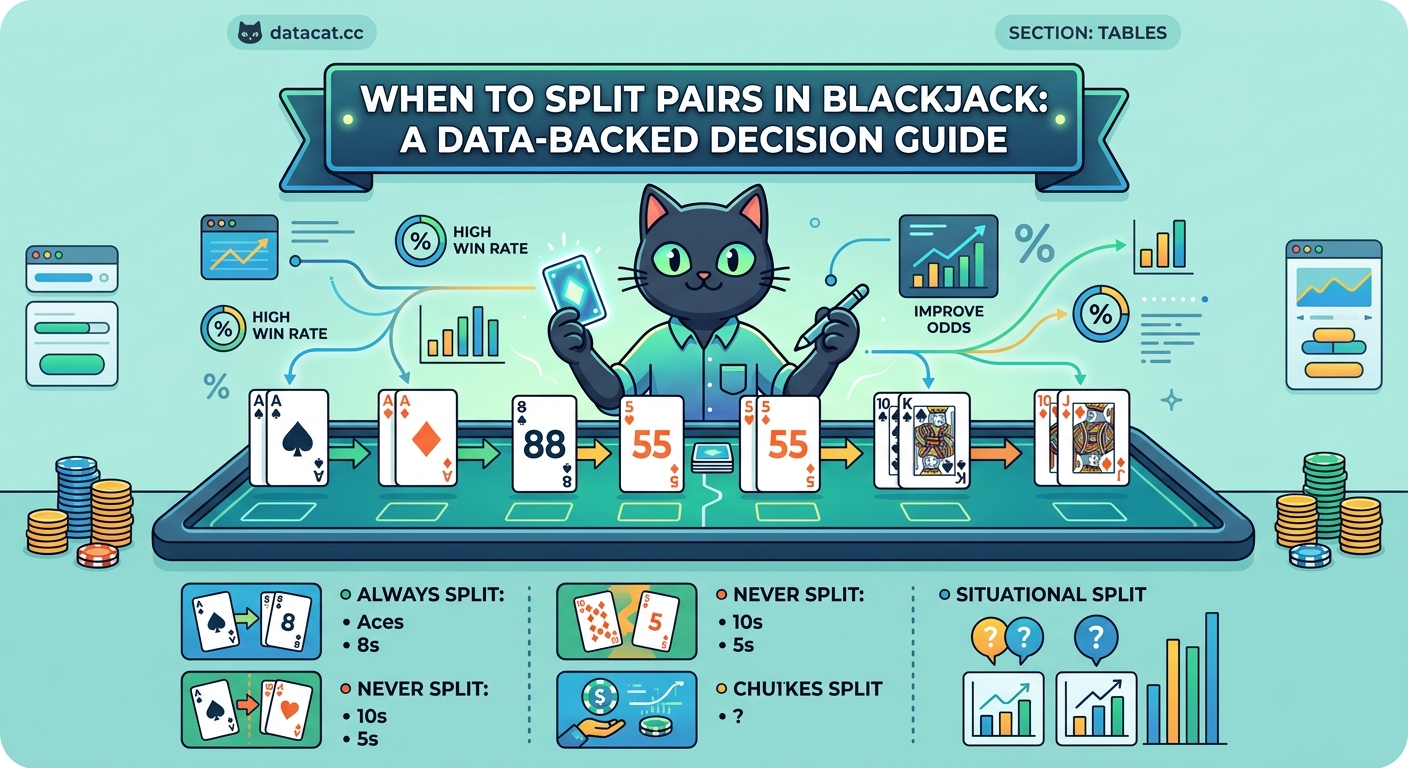
For the remaining pairs (nines, sevens, sixes, fours, threes, and twos), the dealer’s upcard makes all the difference.
Nines: Split against dealer 2 through 6, 8, and 9. Stand against 7, 10, or ace. You already have 18, which beats a dealer 7. Against stronger dealer cards, splitting puts more money at risk without enough upside.
Sevens: Split against dealer 2 through 7. Against 8 or higher, hit instead. Two sevens give you 14, which is weak. Splitting makes sense when the dealer is also likely to struggle.
Sixes: Split against dealer 2 through 6. Hit against 7 or higher. Your 12 is vulnerable, but splitting is only profitable when the dealer is in bust territory.
Fours: Split only against dealer 5 or 6, and only if doubling after split is allowed. Otherwise, hit. Starting two hands with 4 each is marginal at best.
Threes and twos: Split against dealer 2 through 7. Hit against 8 or higher. These low pairs benefit from splitting when the dealer is weak, but you need multiple cards to build competitive totals.
Here’s a breakdown of splitting strategy based on dealer upcards:
| Your Pair | Dealer Shows 2-6 | Dealer Shows 7-9 | Dealer Shows 10 or Ace |
|---|---|---|---|
| Aces | Always split | Always split | Always split |
| Eights | Always split | Always split | Always split |
| Nines | Split | Stand (vs 7), Split (vs 8-9) | Stand |
| Sevens | Split | Hit | Hit |
| Sixes | Split | Hit | Hit |
| Fives | Never split (double instead) | Never split | Never split |
| Fours | Split (vs 5-6 only, with DAS) | Hit | Hit |
| Threes | Split | Hit | Hit |
| Twos | Split | Hit | Hit |
| Tens | Never split | Never split | Never split |
How rule variations affect splitting decisions
Not all blackjack tables use identical rules. Two variations have the biggest impact on splitting strategy.
Doubling after split (DAS): When allowed, this rule lets you double down on one or both hands after splitting. It makes splitting more profitable for pairs like twos, threes, and sixes. If DAS isn’t allowed, you should hit some of these pairs instead of splitting them.
Resplitting: Some tables let you split again if you receive another matching card. For example, you split eights, receive another eight, and can split once more. This option increases the value of splitting certain pairs, especially aces.
Always check the table rules before you sit down. A game that restricts doubling after splits or limits resplitting changes the optimal strategy and increases the house edge.
The step-by-step process for making split decisions
Here’s how to approach every pair you’re dealt:
-
Identify your pair and the dealer’s upcard. Know exactly what you’re holding and what the dealer shows.
-
Check if your pair falls into the “always” or “never” categories. Aces and eights get split no matter what. Tens and fives never split.
-
For other pairs, compare the dealer’s upcard to basic strategy. Use the table above or memorize the key splits for each pair.
-
Consider table rules if you’re on the fence. DAS and resplitting options can shift marginal decisions.
-
Place your second bet and signal the split. In a casino, place chips next to your original bet and tell the dealer you’re splitting. Online, click the split button.
-
Play each hand independently. Make the best decision for each hand based on its total and the dealer’s upcard.
Following this process removes guesswork and keeps you aligned with mathematically optimal play.
Common splitting mistakes that cost you money
Even players who understand the basics make these errors:
- Splitting tens because they “feel lucky.” This is pure ego. You’re throwing away a winning hand.
- Failing to split aces or eights. Fear of putting more money on the table leads some players to skip these essential splits.
- Splitting fours, fives, or sixes against strong dealer cards. The dealer’s 10 or ace means you’re likely to lose both hands.
- Ignoring table rules. Not adjusting for no-DAS or resplitting restrictions leaves money on the table.
- Splitting based on previous hands or streaks. Each hand is independent. Past results don’t change the math.
“Splitting is one of the most powerful tools in blackjack, but only when used correctly. Players who split based on hunches rather than strategy are essentially giving the casino free money. Stick to basic strategy and you’ll see the difference in your bankroll over time.”
Why splitting matters for your overall strategy
Splitting isn’t just about individual hands. It’s part of a complete approach to which casino games have the best odds and how to play them.
When you split correctly, you’re taking advantage of favorable situations where the dealer is vulnerable. You’re also avoiding costly mistakes that compound the house edge.
Basic strategy, including proper splitting, can reduce the house edge in blackjack to around 0.5% or lower. That makes it one of the best bets in the casino, far better than most slot machines or side bets.
If you’re serious about winning at blackjack, memorizing when to split is non-negotiable. It’s not about memorizing charts for the sake of it. It’s about making decisions that are proven to work over thousands of hands.
Practical tips for applying split strategy at the table
Knowing the rules is one thing. Using them under pressure is another.
- Start with the easiest splits. Master aces, eights, tens, and fives first. These four pairs cover the most important decisions.
- Use a strategy card if the casino allows it. Many casinos let you reference a basic strategy card at the table. There’s no shame in checking.
- Practice online before playing for real money. Free blackjack games let you test your split decisions without risk.
- Don’t let other players influence you. Some players will criticize your splits, especially if they don’t understand basic strategy. Ignore them.
- Track your results over time. Splitting correctly won’t win every hand, but it will improve your results over dozens or hundreds of sessions.
The key is consistency. Make the right decision every time, regardless of how the last hand played out.
How splits fit into the bigger picture of blackjack strategy
Splitting is just one piece of basic strategy. You also need to know when to hit, stand, double down, and take insurance (almost never, by the way).
But splitting is unique because it requires you to put more money on the table. That makes it feel riskier, even when the math says it’s the right move.
Think of splitting as an investment. You’re spending an extra bet to create two opportunities instead of one. Sometimes both hands lose. Sometimes both win. Over time, making the correct split decisions adds up to real money saved and earned.
If you’re looking to improve your game, focus on splitting first. It’s easier to learn than card counting and delivers immediate results.
Making the right split every time
Splitting pairs in blackjack isn’t about luck or intuition. It’s about following a proven strategy that reduces the house edge and puts you in the best position to win.
Always split aces and eights. Never split tens or fives. For everything else, let the dealer’s upcard guide your decision. Adjust for table rules like doubling after splits, and don’t let emotions or other players sway you.
Memorize the key splits, practice them until they become automatic, and you’ll play with the confidence of someone who knows they’re making the smartest move possible. The casino still has an edge, but you’re doing everything you can to shrink it.
Now get out there and split like you mean it.