
You’re staring at two versions of the same blackjack table. One has a real dealer shuffling cards on camera. The other runs on software that deals instantly. Both promise fair odds, but they feel completely different to play.
That difference matters more than most players realize.
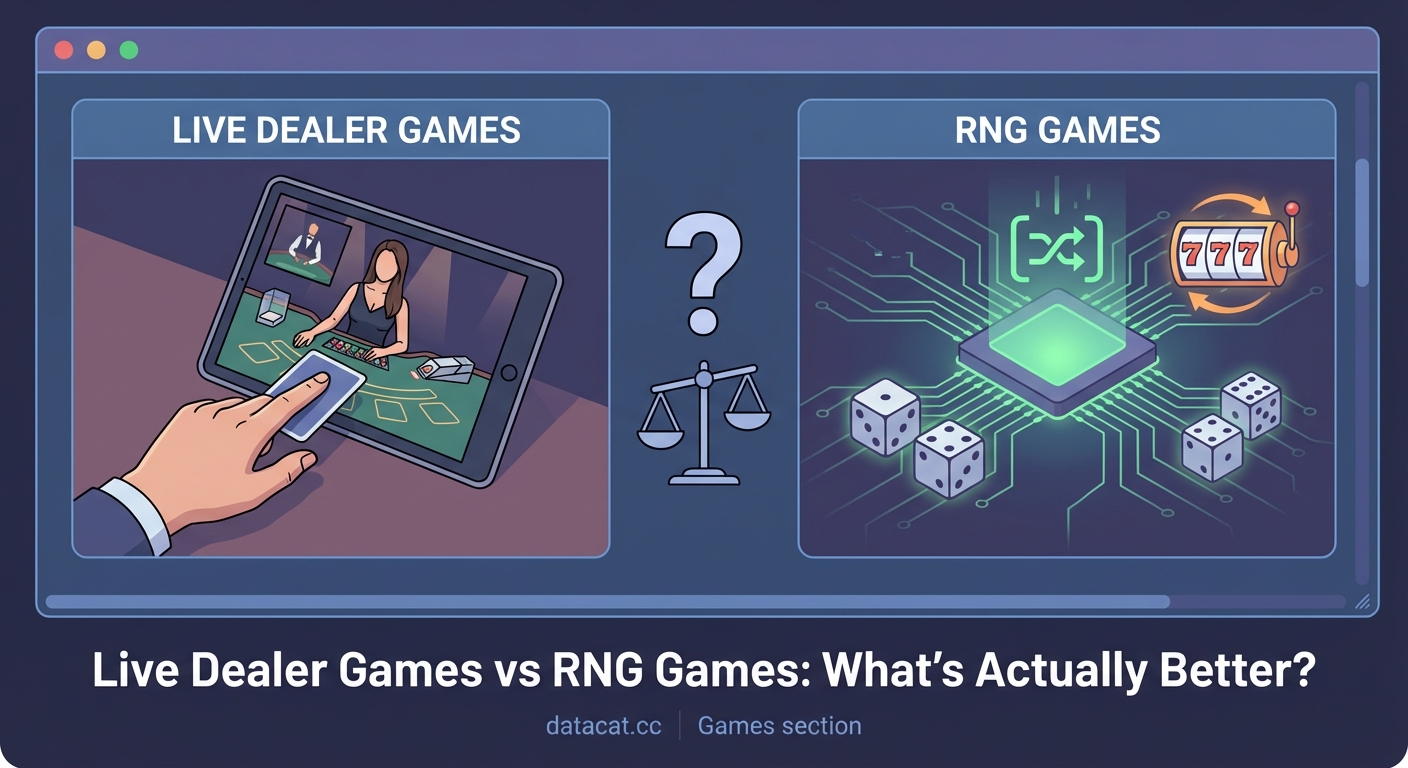
Live dealer games stream real humans dealing physical cards or spinning actual wheels, offering authentic casino atmosphere at higher minimum bets. RNG games use certified random number generators for instant play at lower stakes. Neither format offers better odds, but they serve different player preferences for speed, social interaction, trust factors, and budget constraints. Your ideal choice depends on playing style, bankroll size, and whether you value realism over convenience.
How Each Format Actually Works
RNG stands for random number generator. These games run entirely on software.
A certified algorithm produces unpredictable outcomes millions of times per second. When you click “deal” or “spin,” the game captures whatever number the RNG landed on at that exact microsecond. That number determines your cards, your roulette result, or your slot symbols.
No physical cards exist. No wheel spins. Everything happens in code.
Live dealer games work differently. A real person sits in a studio with physical equipment. Cameras capture every shuffle, deal, and spin. You watch through a video stream and make decisions using on-screen buttons.
The dealer can’t see you, but they acknowledge bets and sometimes chat through audio. Multiple players join the same table remotely, just like a land-based casino floor.
The randomness comes from physical objects, not algorithms. Gravity determines where the roulette ball lands. Card order depends on how thoroughly the dealer shuffles.
The Trust Factor Nobody Talks About
Some players trust physical randomness more than software. They want to see the shuffle with their own eyes.
That feeling isn’t entirely irrational. Rogue software casinos have existed. A few operators in unregulated markets ran rigged RNG games that violated stated odds.
But licensed RNG games face constant scrutiny. Independent testing labs like eCOGRA and iTech Labs audit the software. They run millions of simulated rounds to verify the RNG produces statistically expected results.
Regulators in jurisdictions like Malta, Gibraltar, and the UK require these audits before approving any game for real money play. If you’re playing at a licensed casino, the red flags every player should spot before signing up at an online casino are absent, and the RNG is almost certainly fair.
Live dealer games face different scrutiny. Regulators inspect the studios. They verify dealers follow proper procedures. Some studios use automatic card readers and sensors to prevent human error or manipulation.
“The irony is that live dealer games can have more points of failure than RNG. A distracted dealer might misread a card. Technical glitches can interrupt streams. But players often feel more comfortable watching a human, even if the math says both formats are equally fair.” – Casino operations consultant
Neither format gives the house a bigger edge. A European roulette wheel has the same 2.7% house advantage whether it’s physical or digital. Blackjack odds depend on rules, not whether cards are real or virtual.
Speed and Convenience Compared
RNG games play at your pace. You control every click.
Want to play 300 blackjack hands per hour? You can. Want to take a five-minute break between spins? The game waits.
Live dealer games run on the dealer’s schedule. You’re sharing the table with other players. The dealer must wait for everyone to place bets before dealing.
A typical live blackjack table deals 40 to 60 hands per hour. Live roulette completes 30 to 50 spins hourly. That’s four to six times slower than RNG versions.
This speed difference affects your bankroll exposure. Slower play means fewer bets per hour, which reduces variance. You’ll experience smaller swings in the short term.
But if you’re chasing why progressive jackpot slots pay out more than you think, speed matters. More spins mean more chances at the big prize.
What Each Format Actually Costs
Live dealer games carry higher minimum bets. Studios employ real dealers, maintain physical equipment, and stream video. Those costs get passed to players.
Minimum bets typically start at $5 to $10 per hand. Some VIP tables require $25, $50, or even $100 minimums.
RNG games accept bets as low as $0.10 or $1. You can play hundreds of hands on a modest bankroll.
This cost difference makes RNG games better for practice. New players can learn 7 casino games every beginner should master first without risking serious money.
Live dealer tables suit players with bigger budgets who value the experience over volume.
Game Variety Isn’t Equal
RNG libraries dwarf live dealer offerings. A typical online casino hosts hundreds of RNG slots, dozens of table game variants, and specialty games like keno or scratch cards.
Live dealer sections usually offer:
- Blackjack (multiple tables with varying rules)
- Roulette (European, American, sometimes French)
- Baccarat (standard and speed versions)
- A few poker variants (Caribbean Stud, Three Card, sometimes Texas Hold’em)
- Game show style games (Crazy Time, Monopoly Live, Dream Catcher)
You won’t find live dealer slots. The format doesn’t translate. You also won’t find most specialty games or exotic table variants.
If you want variety, RNG wins. If you want classic table games with atmosphere, live dealer delivers.
Social Experience Differences
Live dealer games create a sense of community. You see other players’ bets. You share wins and losses in real time. Some games include chat features where you can talk to the dealer or other participants.
It’s not the same as sitting at a physical casino table, but it’s closer than clicking buttons alone.
RNG games are solitary. You’re playing against the house with no human interaction. Some players prefer this. No small talk. No waiting for slow decision makers. Just you and the game.
Your personality matters here. Introverts often prefer RNG. People who miss the social element of casino floors gravitate toward live dealers.
How to Choose Based on Your Playing Style
Here’s a simple framework:
- Calculate your typical session budget. If you usually play with $50 or less, RNG games give you more playing time.
- Decide what you value more: speed or atmosphere. Impatient players get frustrated waiting for live dealers. Players who want immersion find RNG games sterile.
- Check which games you actually play. If you love slots or specialty games, live dealer isn’t an option. If you only play blackjack and roulette, both formats work.
The table below shows which format typically suits different priorities:
| Priority | Better Format | Why |
|---|---|---|
| Low minimum bets | RNG | Stakes start under $1 vs $5+ for live |
| Maximum hands per hour | RNG | 4x to 6x faster gameplay |
| Visual confirmation of randomness | Live Dealer | You see physical cards and wheels |
| Playing while multitasking | RNG | Pause anytime without holding up others |
| Social interaction | Live Dealer | Chat features and shared table experience |
| Game variety | RNG | Hundreds of options vs a dozen live tables |
| Authentic casino feel | Live Dealer | Real dealers and equipment |
| Practice on tiny stakes | RNG | Learn without risking serious money |
Strategy Differences You Need to Know
Basic strategy doesn’t change between formats. Optimal blackjack play is identical whether cards are physical or digital.
But execution differs.
In live dealer blackjack, you have limited time to make decisions. The dealer and other players are waiting. If you’re still learning perfect strategy, you might feel rushed.
RNG blackjack lets you consult a strategy chart between every hand. No pressure. No judgment.
Card counting works differently too. Live dealer games typically use eight-deck shoes and shuffle after about 50% penetration. That makes why card counting still works in live dealer blackjack possible but challenging.
RNG blackjack shuffles after every hand. Card counting becomes impossible.
For games like roulette where no strategy affects the house edge, format makes zero mathematical difference. Pick based on preference alone.
Bonus Compatibility Matters
Most welcome bonuses exclude live dealer play or count it at reduced rates.
A typical online casino bonus might work like this:
- Slots: 100% contribution toward wagering requirements
- RNG table games: 10% to 20% contribution
- Live dealer games: 0% to 10% contribution
That means a $100 bet on live blackjack might only count as $10 toward clearing your bonus. The same bet on RNG blackjack counts as $10 to $20.
Always read the terms before deciding how to maximize your casino welcome bonus without losing money. Your format choice directly impacts how fast you clear promotional funds.
Mobile Experience Comparison
RNG games translate perfectly to phones and tablets. They’re designed for touch screens. Graphics scale to any display size. Data usage is minimal.
Live dealer games demand more from your device. Video streaming consumes significant bandwidth. Older phones might struggle with the processing requirements. Small screens make it harder to see card details or roulette numbers.
Most live dealer platforms work on mobile, but the experience is noticeably better on tablets or desktops.
If you primarily play on your phone during commutes or breaks, RNG games are more practical.
Withdrawal Speed Isn’t Actually Different
Some players believe RNG games process cashouts faster because everything is automated.
That’s a myth.
Withdrawal speed depends on the casino’s verification process and your chosen payment method, not which games you played. Whether you won at live dealer roulette or RNG slots, how fast are online casino withdrawals in 2024? payment method comparison shows the same timelines apply.
The casino’s finance team handles all withdrawal requests identically.
Common Misconceptions Cleared Up
“Live dealer games have better odds.”
False. The house edge is determined by game rules, not format. A 3:2 blackjack game has the same edge whether it’s live or RNG.
“RNG games are rigged.”
Not at licensed casinos. Regulatory testing ensures fairness. Unlicensed sites are a different story, which is why you should stick to regulated operators.
“You can’t win big on live dealer games.”
Also false. Maximum bet limits are often higher on live tables. High rollers frequently prefer live dealer for this reason.
“Live dealers can cheat.”
Reputable studios use multiple cameras, supervisors, and sometimes automated card reading technology. Cheating would require coordinated conspiracy and cost the studio its license.
Mixing Both Formats Makes Sense
You don’t have to choose permanently.
Many experienced players use RNG games for practice and high-volume sessions. They switch to live dealer when they want a more engaging experience or plan to play fewer hands at higher stakes.
This hybrid approach lets you match format to mood and bankroll.
Learning how to choose the right casino game for your playing style includes understanding when each format serves you better.
What the Data Says About Winning
Neither format pays better over time. Both operate on the same mathematical house edges.
Your short-term results will vary based on luck, not format. The casino’s advantage grinds away at your bankroll at the same rate either way.
But format affects variance through speed. Playing 300 RNG hands exposes you to more volatility than 60 live dealer hands, even if you bet the same amount per hand.
If you’re trying to understand which casino games have the best odds? a statistical breakdown, focus on the game itself, not whether it’s live or digital.
Technical Requirements to Consider
Live dealer games need stable internet. A dropped connection during a hand can cause confusion about bet status. Most platforms hold your bet and complete the hand even if you disconnect, but you can’t make decisions.
RNG games tolerate spotty connections better. If you disconnect, the game freezes. Nothing happens until you reconnect.
Bandwidth requirements differ significantly:
- RNG games: Less than 1 MB per hour
- Live dealer games: 200 to 400 MB per hour for standard definition, up to 1 GB per hour for HD streams
If you have data caps or unreliable internet, RNG games are safer.
Making Your Decision Today
Start with these questions:
What’s your typical session budget?
Under $50 suggests RNG. Over $100 opens up live dealer options.
How much time do you have?
30 minutes or less favors RNG’s faster pace. Longer sessions can accommodate live dealer’s slower rhythm.
What games do you enjoy?
Slots and specialty games only exist in RNG. Classic table games work in both formats.
Do you value seeing physical randomness?
If yes, live dealer. If you trust certified RNG, either works.
Test both formats with small bets. Your gut reaction after a few sessions will tell you more than any article can.
Finding the Right Fit for You
The live dealer vs RNG games debate has no universal winner. Format preference is personal.
Budget-conscious players and those who value speed lean toward RNG. Players who want atmosphere and don’t mind higher minimums prefer live dealer.
Both formats offer fair odds at licensed casinos. Both can be fun. Both can be profitable or costly depending on luck and decision making.
Try a few hands at each type of table. Notice which format keeps you engaged without frustration. That’s your answer.