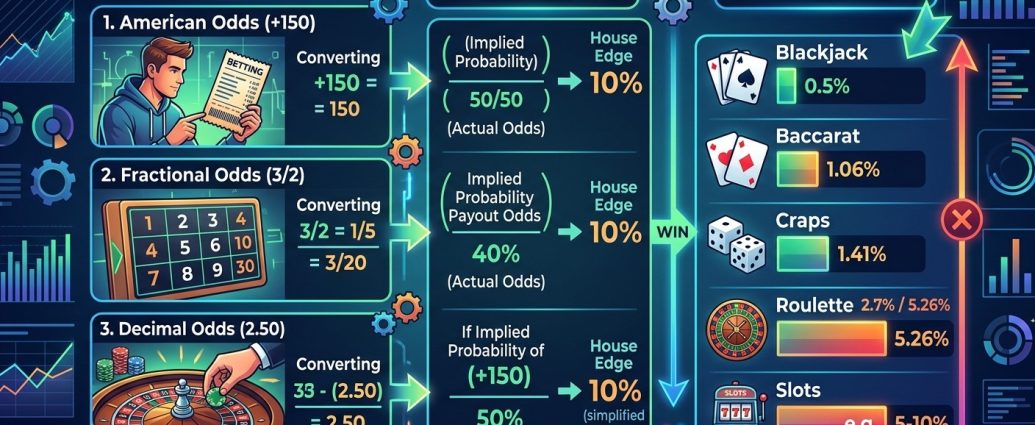
Three different games. Three different payout formats. One mathematical truth hidden beneath all of them. A roulette table showing “35:1,” a blackjack card showing “3 to 2,” and a slot lobby advertising “96% RTP” are all expressing the same concept in different dialects. Players who can translate between those dialects stop guessing and start measuring. That shift changes every decision they make at the table.
Number Cruncher’s Cheat Sheet
- Convert everything to decimal odds first , it is the cleanest base for any house-edge calculation.
- Implied probability = 1 divided by decimal odds. That single formula links all three formats together.
- House edge is the gap between what the casino pays (implied probability) and the true probability of the outcome.
- A slot’s RTP percentage and a roulette payout ratio can be placed on the same edge scale once you know the conversion steps.
- With basic strategy, blackjack holds a smaller house edge than either European roulette or a typical 96% RTP slot.
Why Three Odds Formats Exist in the First Place
Fractional odds, decimal odds, and American odds didn’t emerge from a single design meeting. Each format evolved separately within its own betting culture and stuck around because that culture got comfortable with its shorthand.
Fractional odds are the British horse-racing tradition. They express profit relative to stake. A price of 5/1 means five units of profit returned for every one unit wagered, plus the stake back. Total return: six units.
Decimal odds are the European standard and the most calculation-friendly of the three. The decimal figure is the total return per unit staked, stake included. A price of 6.00 is identical to 5/1 fractional. You just do not need to add 1 manually.
American odds index to 100 using a plus/minus system. A +500 line pays $500 profit on a $100 bet. A -200 line requires a $200 bet to win $100 profit.
Casino games inherited these formats from different traditions. Roulette and craps use fractional-style ratios. Slots report expected return as a percentage. Blackjack lays out payout ratios. All three formats describe the same underlying thing: how much money comes back relative to how much went in.
What Each Format Is Actually Telling You
- Fractional odds , profit per unit staked, not including the returned stake. Add 1 to convert to decimal.
- Decimal odds , total return per unit staked, stake included. The cleanest form for probability math because implied probability = 1 divided by decimal odds.
- American odds (positive) , profit on a $100 stake. Divide by 100 and add 1 to get decimal.
- American odds (negative) , stake required to profit $100. Divide 100 by the absolute value, then add 1 to get decimal.
- RTP percentage , long-run return per unit wagered. Divide by 100 for the return ratio. House edge = 1 minus this ratio.
A Step-by-Step Conversion Process
This ordered process covers every format you will encounter across casino game types. Run through it once with real numbers and the pattern becomes automatic.
- Identify your starting format. Is the payout shown as a fraction (3/2), a ratio (35:1), a moneyline (+300), or a percentage (96%)?
- Convert to decimal. Fractional: (numerator divided by denominator) + 1. Positive American: (odds divided by 100) + 1. Negative American: (100 divided by the absolute value of odds) + 1. Percentage: divide by 100 to get the return ratio.
- Calculate implied probability. For decimal odds: 1 divided by the decimal figure. For RTP ratios: the ratio is already the return probability, and the house edge is visible as 1 minus that ratio.
- Compare against true probability. Find the actual probability of the outcome from the game’s rules. The gap between true probability and what the casino’s payout implies is the house edge.
- Verify before committing to the arithmetic. Running your conversions through an odds converter before applying the edge formula catches small errors that compound into meaningless final figures.
Working Through Three Real Examples
Formulas only earn their keep when applied to numbers you actually see at a casino. Here are three worked examples, one per game type, using the conversion process above.
European Roulette: Straight-Up Bet at 35/1
Payout: 35/1 fractional. Convert to decimal: (35 divided by 1) + 1 = 36.00.
Implied probability: 1 divided by 36 = 0.02778, or about 2.78%.
True probability on a 37-pocket wheel: 1 divided by 37 = 0.02703, or 2.70%.
House edge: this simplifies to 2 divided by 37 = 2.70%. That figure is consistent across every bet type on a European wheel, which is what makes it such a clean benchmark.
Blackjack Natural: the 3/2 Payout
The 3:2 payout on a blackjack natural converts to decimal as (3 divided by 2) + 1 = 2.50. The natural itself is paid at full mathematical value. The house edge in blackjack does not come from the natural payout. It comes from the dealer’s structural advantage and game rules. With standard six-deck rules and correct basic strategy, the overall house edge lands at roughly 0.50%.
One rule change illustrates how much payout format matters. Casinos that drop the natural payout from 3:2 to 6:5 reduce the decimal equivalent from 2.50 to 2.20. That single change pushes the overall house edge up by approximately 1.4 percentage points. Same game, different notation on the felt, materially different cost.
Slot Machine: 96% RTP
Return ratio: 0.96 per unit wagered. House edge: 1 minus 0.96 = 0.04, or 4.00%. There is no fractional payout notation attached to a slot. The RTP is already the summary statistic. In the same terms as the other two examples, the slot’s edge is simply 4.00%.
Three Games on One Comparable Scale
| Game | Native Payout Format | Decimal Equivalent | House Edge |
|---|---|---|---|
| European Roulette (straight-up) | 35/1 fractional | 36.00 | 2.70% |
| Blackjack (basic strategy, 3:2 natural) | 3/2 fractional | 2.50 | ~0.50% |
| Slot Machine (96% RTP) | 96% RTP | 0.96 return ratio | 4.00% |
The rankings flip relative to how each game presents itself at face value. The slot’s near-guarantee RTP label carries the highest edge. The blackjack payout that looks modest is actually the cheapest game by a significant margin. Roulette sits between them. The unified scale made that visible. The raw formats never would have.
Where the Framework Extends Beyond These Three Games
The three-game comparison above is not a one-off exercise. The same process applies to any game that quotes a payout. Baccarat, craps, video poker, live dealer side bets , they all use one of the three formats, and they all reduce to a decimal return ratio and a house edge percentage once you apply the four-step conversion.
The formal basis for this arithmetic sits within gambling mathematics, specifically the expected value framework that treats every bet as a probability-weighted sum of outcomes. Converting to decimal odds is the step that makes expected value calculations consistent across notations.
Two important constraints are worth flagging before you apply this framework to your own game selection:
- A slot’s RTP is a long-run average across millions of spins. Session-to-session variance from high volatility means the 4% edge describes the statistical cost per spin over time, not what happens in any given hour of play.
- Blackjack’s 0.50% edge assumes correct basic strategy on every single hand. Deviations from optimal play raise the effective edge sharply. The payout format is accurate; the edge figure is conditional on your execution.
One Number That Ties Every Game Together
Every payout format , fractional, decimal, American, RTP percentage , resolves to a single figure: the fraction of each wagered unit the house expects to retain. Convert to decimal. Calculate implied probability. Compare to true probability. The edge falls out of that arithmetic reliably, regardless of which game you are analyzing.
Roulette’s 35/1 payout looks enormous. Blackjack’s 3:2 natural looks modest. A slot’s 96% RTP looks like a near-certainty. Placed on the same decimal scale, those impressions invert. Blackjack is the cheapest game of the three. The slot costs the most per unit, regardless of how its return is labeled. European roulette falls in the middle.
That reordering is what the unified format gives you. Casinos do not advertise house edges. You read the payout notation, run four arithmetic steps, and the actual cost becomes visible. That is a durable analytical skill, transferable to any game in any casino that quotes a payout, and it does not require special tools or insider knowledge. Just the conversion, the true probability, and the arithmetic.