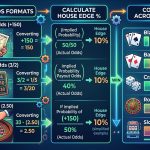
Every casino game you have ever played was built on a mathematical promise. It is a promise that says the casino, over enough time, will take more money than it gives back. This is not luck. It is not cheating. It is a simple, fixed number called the house edge. Understanding that number is the single most important thing you can do as a player. It changes how you see every spin, every hand, and every roll of the dice.
The house edge is a built in mathematical advantage that guarantees casino profit over time. It works because casinos have a nearly unlimited bankroll and can survive short term losses. Players cannot beat the edge in the long run, but they can choose games with a smaller edge to stretch their bankroll and play longer.
What Is the House Edge, Really?
The house edge is the average profit the casino expects to keep from every bet placed. If a game has a house edge of 5 percent, that means the casino expects to keep $5 for every $100 wagered over the long run. The other $95 gets paid back to players as winnings.
This number is not a guess. It is calculated from the rules of the game before a single card is dealt or a single reel spins. Casinos do not need to rig anything. The math does the work for them.
Think of it like a tax on every bet. You do not notice it on a single hand. But over thousands of bets, that tax adds up to a guaranteed profit.
How the House Edge Works in Real Games
The easiest place to see the house edge is on a roulette wheel. A European roulette wheel has 37 slots: numbers 1 through 36 plus a single zero. If you bet $1 on a single number, the true odds of winning are 1 in 37. But the casino does not pay you 37 times your bet. It pays you 35 times your bet.
That difference of 2 units is the house edge. Let us break it down.
If you bet $1 on every number on the wheel, you would spend $37. The winning number pays you $35 plus you keep your original $1 bet. So you end up with $36. The casino keeps $1. That $1 out of $37 is a house edge of about 2.7 percent.
American roulette is even worse. It has an extra slot for double zero, making 38 total slots. The payout is still 35 to 1. The house edge jumps to 5.26 percent.
Here is a table that shows how the edge varies across popular games.
| Game | Typical House Edge | Notes |
|---|---|---|
| Blackjack (basic strategy) | 0.5% to 2% | Depends on rules and number of decks |
| European Roulette | 2.70% | Single zero wheel |
| American Roulette | 5.26% | Double zero wheel |
| Craps (pass line bet) | 1.41% | One of the best bets on the floor |
| Slot Machines | 2% to 15% | Varies wildly by machine and jurisdiction |
| Baccarat (player bet) | 1.06% | Very low edge for a table game |
Notice that blackjack can have a very low edge if you play perfect basic strategy. That is why it is one of the most popular games for players who want to stretch their money.
The Secret Weapon: The Gambler’s Ruin Problem
There is a famous mathematical concept called the Gambler’s Ruin problem. It explains exactly why the house always wins in the long run.
Imagine you and a friend flip a fair coin. You each start with $100. You bet $1 on heads, your friend bets $1 on tails. Over many flips, the coin is fair, so you both break even. But what if the coin is slightly biased? What if heads comes up 50.5 percent of the time instead of 50 percent?
In that case, the player betting on heads will eventually take all the money. It might take a while, but the math guarantees it. The player with the edge wins everything.
Casinos are the player with the biased coin. Their edge is small, but it is real. And they have a massive bankroll. You, the player, have a limited bankroll. That combination means you will eventually lose everything if you play long enough.
The Gambler’s Ruin theorem tells us that if one player has a finite bankroll and the other has an infinite bankroll, the finite player will go broke with certainty, even if the game is fair. Casinos have a bankroll that is effectively infinite compared to any single player.
This is not a theory. It is a proven mathematical law.
Return to Player: The Other Side of the Coin
You will often see the term Return to Player, or RTP. This is the percentage of all wagered money that a game pays back to players over time. It is the flip side of the house edge.
If a slot machine has an RTP of 96 percent, the house edge is 4 percent. The two numbers always add up to 100 percent.
Many online casinos publish RTP figures for their slot games. This is a helpful way to compare games. A slot with a 97 percent RTP is better for the player than one with a 92 percent RTP. But remember, RTP is an average over millions of spins. Your individual session can vary wildly.
For a deeper look at which games give you the best statistical chance, check out our guide on which casino games have the best odds.
Three Steps to Calculate the House Edge Yourself
You do not need to be a math genius to figure out the edge on any game. Here is a simple process you can follow.
-
Find the true odds of winning. Count all possible outcomes. For a single number in European roulette, there are 37 possible outcomes. Your chance of winning is 1 in 37.
-
Find the payout odds. This is what the casino pays you for a winning bet. For that same roulette bet, the payout is 35 to 1. That means you get $35 for every $1 you bet, plus your original $1 back.
-
Calculate the expected value. Multiply the probability of winning by the payout. Then subtract the probability of losing. For the European roulette example, it looks like this:
- Chance of winning: 1/37 times $35 = $0.9459
- Chance of losing: 36/37 times $1 = $0.9729
- Expected value: $0.9459 minus $0.9729 = negative $0.027
- That means you lose about 2.7 cents per dollar bet. That is a house edge of 2.7 percent.
You can use this same formula on any game. Blackjack is harder because the odds change with every card, but the principle is the same.
Why Short Term Luck Does Not Matter
Here is the part that tricks most players. The house edge only shows up over a very large number of bets. In the short term, anything can happen. A player can hit a lucky streak and win ten hands of blackjack in a row. Another player can lose twenty spins in a row on roulette.
This randomness is what keeps people playing. They see a friend win big and think they can do the same. But the casino does not care about short term results. It cares about the long term average.
Imagine a casino runs 100,000 hands of blackjack in one night. With a 1 percent house edge, the casino expects to make about 1 percent of all the money wagered. Some players will win. Some will lose. But the casino’s profit is almost guaranteed because the number of bets is so large.
This is why casinos can afford to pay out huge jackpots. They know that over time, the math brings the money back.
Common Mistakes Players Make
Many players misunderstand how the house edge works. Here are the most common errors.
- Believing in hot streaks. A win streak does not change the odds of the next bet. Every spin of the roulette wheel is independent. The wheel has no memory.
- Chasing losses. Doubling your bet after a loss to try to win back your money is called the Martingale system. It seems smart, but it fails because you can run out of money before you win. And many tables have maximum bet limits that stop you.
- Thinking all games are the same. The house edge varies a lot from game to game. Playing American roulette instead of European roulette costs you twice as much in expected value.
- Ignoring the rules. In blackjack, a game that pays 6 to 5 on a blackjack instead of the standard 3 to 2 has a much higher house edge. Always check the rules before you sit down.
If you want to see how these mistakes drain your bankroll, read our article on the 5 biggest betting mistakes that drain your casino bankroll.
Can You Ever Overcome the House Edge?
In the pure mathematical sense, no. You cannot beat the house edge over a long period of time. The numbers are fixed. But there are a few things that can shift the balance in your favor temporarily.
- Skill based games. Blackjack is the most famous example. If you learn perfect basic strategy, you can reduce the house edge to under 0.5 percent. If you add card counting, you can actually gain a small edge. But casinos watch for counters and will ban you if they catch you.
- Casino promotions and bonuses. Online casinos often offer welcome bonuses, cashback, and free spins. These can give you extra value that offsets the house edge in the short term. Our guide on how to maximize your casino welcome bonus without losing money explains how to use these offers wisely.
- Choosing the right games. Some games have a very low house edge. Baccarat, craps, and blackjack are among the best. Slots and keno are among the worst.
But remember, none of these strategies guarantee a win. They just improve your chances of having a longer, more enjoyable session.
What This Means for Your Next Trip to the Casino
Understanding the house edge changes how you play. You stop chasing the big win and start focusing on value. You look for games with the lowest edge. You set a budget and stick to it. You treat your bankroll as an entertainment expense, not an investment.
If you want to see how the math works out for your favorite games, try our guide on how to calculate your expected loss per hour in any casino game. It will help you plan your sessions and avoid surprises.
The House Edge Is Not the Enemy
The house edge is not a dirty secret. It is the reason casinos can stay open. It pays for the lights, the staff, the drinks, and the entertainment. Without it, there would be no casino to play in.
As a player, your goal is not to beat the house edge. Your goal is to understand it so you can make smarter choices. Play games with a small edge. Use good strategy. Take advantage of bonuses. And most importantly, know when to walk away.
The next time you sit down at a table or click spin on a slot, remember the math. The house has a tiny, quiet advantage. It is not unbeatable in a single session, but it is unbeatable over a lifetime. Play for the fun. Play for the thrill. But never play thinking you can outrun the numbers.