Doubling down is one of the most powerful moves in blackjack, but most players leave money on the table because they don’t know when to use it. This single decision can swing your expected value by several percentage points, yet many beginners either double at the wrong times or miss profitable opportunities entirely. Understanding the math behind this play transforms it from a gamble into a calculated advantage.
Doubling down means doubling your original bet in exchange for receiving exactly one more card. The optimal times to double are when you hold 11 against any dealer upcard, 10 against dealer cards 2 through 9, and 9 against dealer cards 3 through 6. Soft hands like Ace-6 and Ace-7 also benefit from doubling against weak dealer upcards. Following [basic strategy](https://en.wikipedia.org/wiki/Blackjack) for doubling reduces the house edge to under 0.5%.
What doubling down actually means
Doubling down lets you double your initial wager after seeing your first two cards. The tradeoff is simple: you get exactly one additional card, then your turn ends automatically.
This move exists because certain situations heavily favor the player. When you’re likely to make a strong hand and the dealer shows weakness, doubling maximizes your profit on that single hand.
The mechanics work like this: you place an additional bet equal to your original wager next to your first bet. The dealer gives you one card face up, and that’s it. You can’t hit again, even if you receive a low card.
Most casinos allow doubling on any two-card total. Some restrict it to hard 9, 10, or 11 only. Always check table rules before sitting down.
The math behind profitable doubles
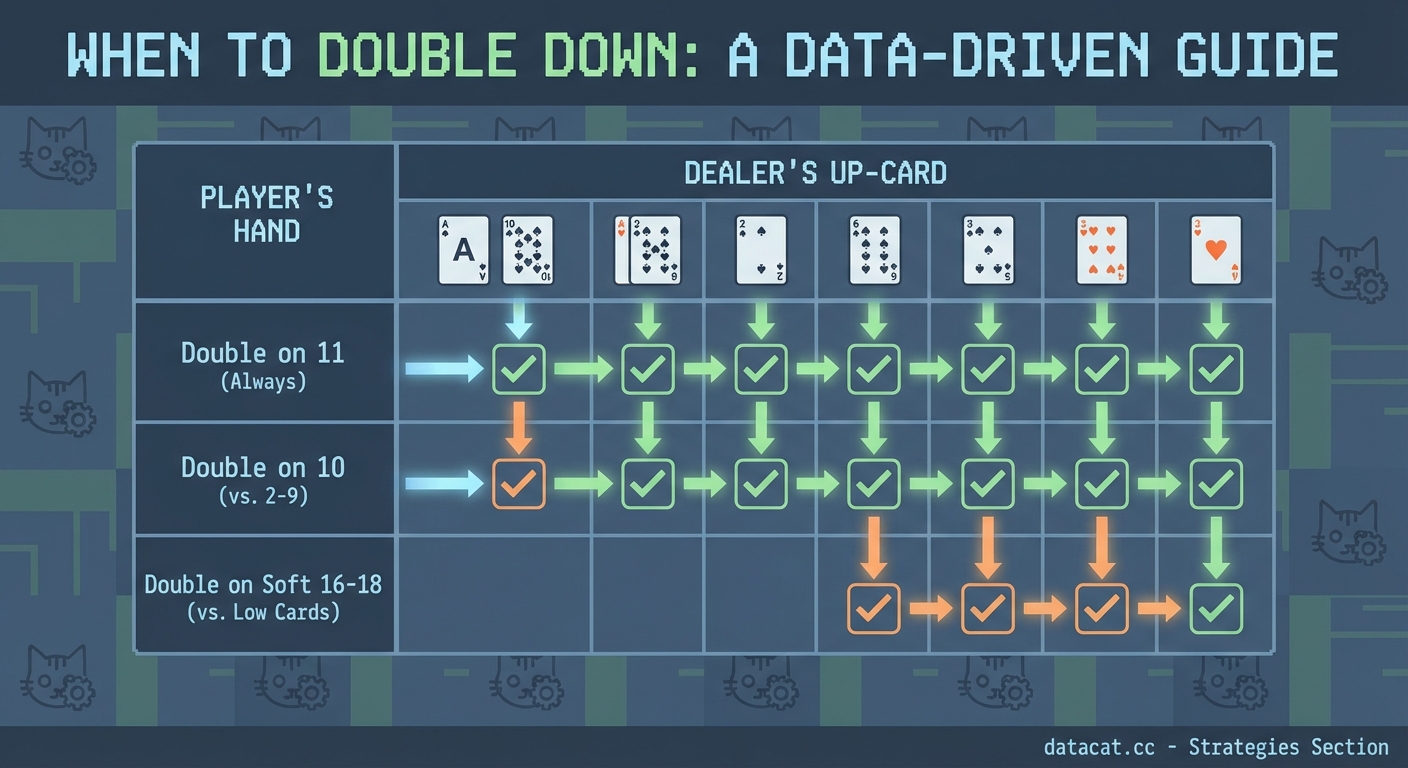
Basic strategy for doubling down comes from computer simulations that played millions of hands. The math considers your total, the dealer’s upcard, and the probability of different outcomes.
When you hold 11, you can’t bust with one card. You have a strong chance of making 21 or 20. Against any dealer upcard, the expected value of doubling exceeds just hitting.
With 10, you’re likely to make 20. This beats most dealer hands. The only time you don’t double is when the dealer shows 10 or Ace, because their chances of making 20 or 21 are too high.
The number 9 is trickier. You only double when the dealer shows 3 through 6. These are the dealer’s weakest upcards, with the highest bust rates. Your 9 becomes profitable to double because the dealer will likely bust before you need to beat a strong total.
The house edge in blackjack drops from around 2% with poor play to under 0.5% when you follow basic strategy perfectly. Doubling at the right times accounts for a significant portion of that reduction.
Hard totals and when to double them
Hard hands don’t contain an Ace counted as 11. These are the foundation of doubling strategy.
Always double on 11
This is the golden rule. Against any dealer upcard, doubling on 11 is mathematically correct. You have the best possible starting total for receiving one more card.
Even against a dealer Ace, where some players hesitate, doubling 11 remains the right play. Yes, the dealer might have blackjack, but when they don’t, your advantage is substantial enough to justify the double.
Double on 10 against dealer 2 through 9
When you hold 10, you’re one card away from 20. The dealer showing 2 through 9 gives you enough edge to double your money.
Don’t double 10 against dealer 10 or Ace. The dealer’s chances of matching or beating your likely 20 are too high. Just hit instead.
Double on 9 against dealer 3 through 6
This narrower range reflects the dealer’s bust probability. When they show 3, 4, 5, or 6, they’ll bust frequently enough that your 9 becomes worth doubling.
Against dealer 2, 7, 8, 9, 10, or Ace, just hit your 9. The dealer is either too likely to make a hand or too strong for doubling to be profitable.
Soft hands create unique opportunities
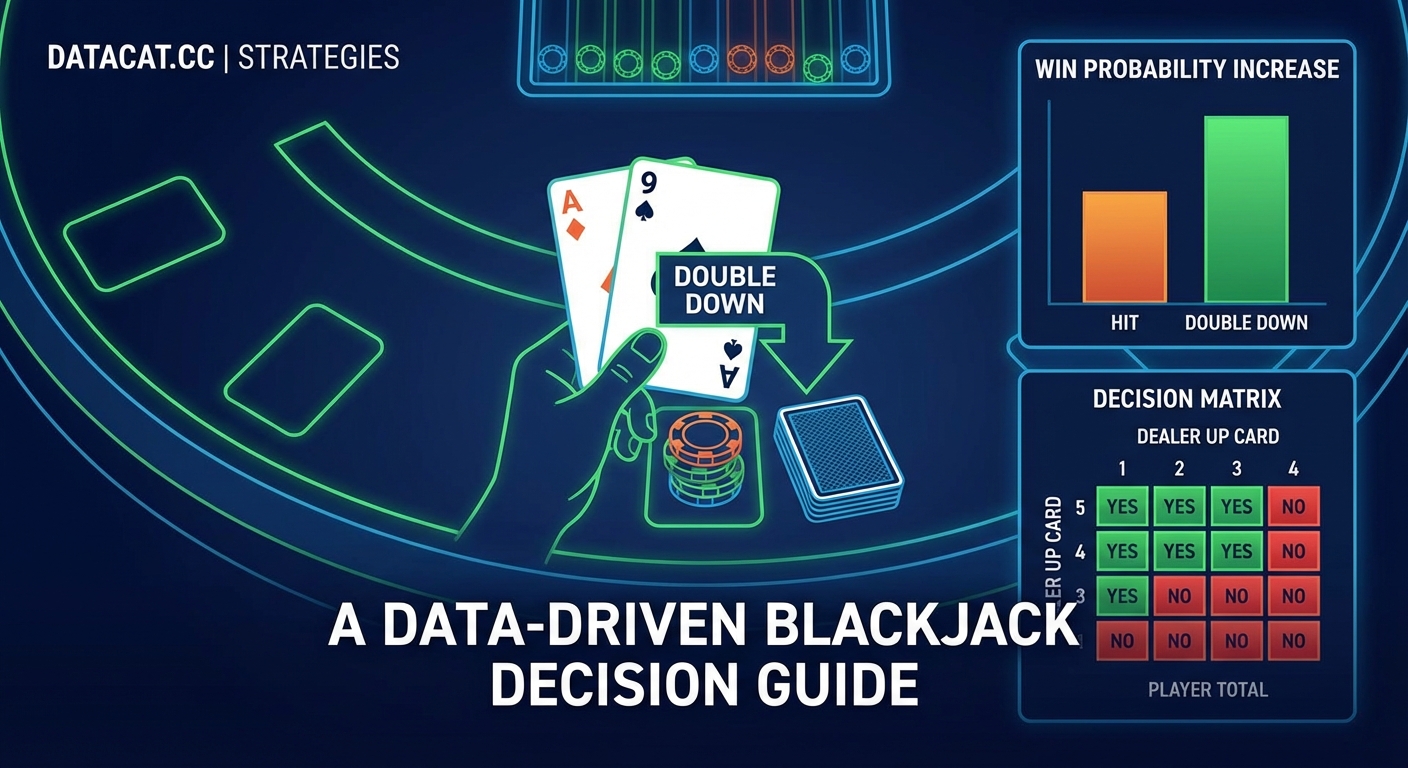
Soft hands contain an Ace counted as 11. These totals give you flexibility because the Ace can revert to 1 if you bust.
The most important soft doubles are Ace-6 and Ace-7 against dealer 3 through 6. These situations surprise many players because the totals seem weak.
Ace-6 (soft 17) against dealer 3 through 6
Soft 17 is a mediocre hand. But against the dealer’s weakest upcards, doubling becomes profitable. You might catch a 3 or 4 for a strong total, or even an Ace or face card for 18 or 17.
The key is the dealer’s high bust rate. You don’t need to make a great hand. You just need the dealer to fail.
Ace-7 (soft 18) against dealer 3 through 6
Soft 18 feels like a hand to stand on. Against weak dealer cards, though, doubling extracts more value. You already have a decent total, and adding one card either improves it or keeps it the same.
Against dealer 2, hit instead of doubling. Against dealer 7 or 8, stand. Against dealer 9, 10, or Ace, hit because your 18 is likely losing.
Other soft doubles
Ace-2 through Ace-5 should be doubled against dealer 5 or 6 in most games. These plays are more advanced and depend on specific table rules about soft doubling.
Ace-8 and Ace-9 are strong enough to stand. Never double these totals.
Common situations that trick players
Certain hands tempt players to double when they shouldn’t, or to skip doubling when they should.
Don’t double 12 or higher hard totals
Some players see a dealer 6 and want to double any hand. Resist this urge with 12 or higher. The bust risk is too high for the reward.
Doubling means you get one card. With 12, a 10-value card busts you immediately. The math doesn’t support it.
Don’t double soft 19 or 20
These are already winning hands. Taking one card risks turning a winner into a loser for minimal additional gain.
Do double 11 even when nervous
New players often hit 11 instead of doubling because they fear losing the extra bet. This costs them money over time. The statistics overwhelmingly support doubling.
Do double soft hands against weak dealers
Many players miss soft doubles entirely. They see Ace-6 as 17 and stand, or they hit without doubling. Both plays are suboptimal against dealer 3 through 6.
Table rules that change your strategy
Not all blackjack tables offer the same doubling rules. These variations affect which hands you should double.
Some tables restrict doubling to hard 9, 10, or 11 only. This rule hurts players by removing profitable soft doubles. Avoid these tables when possible.
Other tables allow doubling after splitting pairs. This is a player-friendly rule. If you split 8s and receive a 3 on one hand, you can double that 11.
A few tables let you double for less than your original bet. Never do this. If the situation calls for doubling, the math says to double the full amount. Doubling for less gives up expected value.
Spanish 21 and other variants have different doubling strategies because they use modified decks. Always learn the specific basic strategy for the game you’re playing, including games you might find when comparing live dealer games vs RNG games.
Step-by-step guide to doubling down
Follow this process every time you consider doubling:
- Check your two-card total and identify whether it’s hard or soft.
- Look at the dealer’s upcard.
- Consult the basic strategy chart for your specific total and the dealer’s card.
- If the chart says double, place an equal bet next to your original wager.
- Receive your one additional card and wait for the dealer to complete their hand.
- Collect your winnings or accept the loss based on the final outcome.
Never let emotions override the chart. If you hold 11 against a dealer 10 and basic strategy says double, do it. The math accounts for all possible outcomes over thousands of hands.
Mistakes that cost you money
Players make predictable errors with doubling that drain their bankroll over time.
| Mistake | Why it hurts | Correct play |
|---|---|---|
| Hitting 11 instead of doubling | Gives up expected value on the best doubling hand | Always double 11 |
| Doubling 12+ hard totals | High bust risk with no reward | Only double 9, 10, 11 for hard hands |
| Ignoring soft doubles | Misses profitable situations against weak dealers | Double Ace-6 and Ace-7 against 3-6 |
| Doubling for less | Reduces profit on positive expectation plays | Always double the full amount |
| Doubling soft 19 or 20 | Risks turning winners into losers | Stand on these strong totals |
The biggest leak is simply not doubling enough. Conservative players leave money on the table by hitting when they should double. Aggressive players do the opposite, doubling in negative expectation situations.
Bankroll considerations for doubling
Doubling requires putting more money at risk. This affects your bankroll management.
You need enough funds to handle the variance. If you’re betting $10 per hand and doubling frequently, you’ll have $20 at risk multiple times per hour.
A good rule is to have at least 30 betting units for your session. If you bet $10, bring $300. This cushion lets you double when appropriate without fear of going broke on normal variance.
Don’t reduce your base bet size just to have money for doubles. Instead, choose a base bet that fits your bankroll while allowing for doubles and splits.
Some players set aside “double money” mentally. This helps them commit to the play when the situation arises. If you know you have $100 reserved for doubles, you won’t hesitate on that 11 versus dealer 6.
Practice makes perfect
Learning when to double down takes repetition. Start by memorizing the core situations:
- Always double 11
- Double 10 against 2 through 9
- Double 9 against 3 through 6
- Double Ace-6 and Ace-7 against 3 through 6
These four rules cover the vast majority of doubling situations. Master them before adding the more nuanced soft hand doubles.
Use free online blackjack games to practice. Many sites let you play without wagering real money. This builds muscle memory for recognizing doubling opportunities.
Track your sessions and note how often you double. If you’re doubling less than once per shoe, you’re probably missing opportunities. If you’re doubling more than five times per shoe, you might be overusing the move.
Consider starting with games that help beginners build fundamentals before focusing exclusively on blackjack strategy.
How doubling fits into overall strategy
Doubling is one piece of basic strategy, alongside hitting, standing, and splitting. These decisions work together to minimize the house edge.
Understanding which casino games offer the best odds helps you appreciate why blackjack, played correctly, ranks among the best bets in the casino.
Splitting pairs creates additional doubling opportunities. When you split 8s and catch a 3, you now have 11. That’s a mandatory double in most situations.
Insurance and even money are separate decisions that don’t interact with doubling. Generally, avoid insurance even when you’re about to double. The math on insurance is negative regardless of your hand.
Card counting adds another layer. Counters adjust their doubling strategy based on the count. In positive counts, they double more aggressively. In negative counts, they might skip marginal doubles. This is advanced play beyond basic strategy.
Real examples from the table
Seeing these plays in context helps cement the strategy.
Example 1: You hold 6-5 for 11. Dealer shows 7. You double and receive a 4 for 15. The dealer flips a 10 in the hole for 17. You lose both bets. This is still the correct play. Over thousands of hands, doubling 11 profits more than hitting.
Example 2: You hold Ace-6 for soft 17. Dealer shows 5. You double and catch a King for 17. Dealer has 15 and busts. You win double your bet. This is a textbook soft double.
Example 3: You hold 10-2 for 12. Dealer shows 6. You’re tempted to double because the dealer is weak. You resist and hit instead, catching a 9 for 21. The dealer busts anyway. Not doubling was correct because 12 has too much bust risk.
Example 4: You hold 5-4 for 9. Dealer shows 7. You hit instead of doubling and catch a 10 for 19. Dealer makes 20. You lose one bet instead of two. This was the right play. You only double 9 against 3 through 6.
Each of these hands played out over a few seconds, but the decisions were made before the cards were dealt based on basic strategy charts derived from millions of simulations.
Variations across different blackjack games
European blackjack deals the dealer’s second card after players act. This changes doubling strategy slightly because you can’t lose to a dealer blackjack when you double.
Atlantic City rules typically allow doubling after splitting and offer surrender. These player-friendly rules make doubling slightly more valuable.
Vegas Strip rules are similar but may vary by casino. Always check the specific table rules posted on the felt.
Single-deck games have slightly different basic strategy for doubling because card removal effects are stronger. With fewer cards in play, taking two cards that total 11 affects the remaining deck composition more significantly.
Six-deck and eight-deck shoes are most common. Basic strategy charts for these games are nearly identical. The differences are tiny and only matter to card counters.
If you’re choosing games based on your playing style, understanding these rule variations helps you pick the best blackjack table.
Why dealers and pit bosses watch doubles
Casinos know that proper doubling strategy is a sign of a skilled player. Dealers and floor staff notice players who double correctly.
This doesn’t mean you’ll get backed off for doubling 11. It means the casino recognizes you’re not a complete beginner. They’ll watch to see if you’re counting cards or just playing basic strategy.
Playing perfect basic strategy is legal everywhere. Casinos can’t ban you for it. They just prefer players who make mistakes.
Some dealers will even help you if you forget to double. They’re not supposed to give strategy advice, but a friendly dealer might say “you can double that if you want” when you hold 11. This is a courtesy, not a requirement.
Pit bosses track your average bet and how you play. Doubling at the right times marks you as a knowledgeable player, which might affect your comp rating slightly. Casinos give better comps to players they think will lose more money.
Doubling in tournaments versus cash games
Tournament blackjack changes the math because you’re competing against other players, not just the house.
In the final hands of a tournament, you might double hands you’d never double in a cash game. If you’re behind and need to catch up, doubling a marginal hand creates variance that could vault you into first place.
Conversely, if you’re ahead near the end, you might skip profitable doubles to reduce variance and protect your lead.
Cash game strategy is pure math. Every decision aims to maximize expected value over infinite hands. Tournament strategy is situational and depends on your chip position, the other players’ stacks, and how many hands remain.
Don’t practice tournament strategy if you’re learning basic strategy for cash games. They’re different skills. Master cash game doubling first.
Building confidence in your doubles
Many players know the correct doubling strategy but hesitate at the table. Building confidence takes time.
Start at lower stakes where losing a double bet doesn’t sting as much. A $5 table lets you double for $10 total risk. This is easier to stomach than doubling for $100 at a $50 table.
Track your results over several sessions. You’ll notice that doubling 11, even when you lose individual hands, contributes to overall profit. Seeing this pattern in your own play builds trust in the strategy.
Play with friends who also know basic strategy. They’ll reinforce correct decisions and catch mistakes. Having someone say “nice double” when you correctly double Ace-6 against a 5 reinforces the behavior.
Accept that you’ll lose doubled hands regularly. Doubling increases variance. You’ll win bigger when you win and lose bigger when you lose. Over time, the extra profit from optimal doubling adds up.
If you’re exploring different formats, you might find that live dealer platforms offer a less intimidating environment for practicing doubles than crowded casino floors.
Advanced doubling concepts
Once you’ve mastered basic strategy doubles, a few advanced concepts exist.
Composition-dependent strategy considers the specific cards in your hand, not just the total. For example, 5-5 versus 3-7 for a total of 10. The math is nearly identical, but in single-deck games, slight differences emerge.
These differences are tiny. They matter to professional players grinding out every 0.01% of edge. For most players, total-dependent strategy (just looking at the total) is sufficient.
Doubling for less is allowed at some tables but never optimal. If the situation calls for doubling, the math says double the full amount. Anything less gives up expected value.
Some players ask about doubling for more than their original bet. This isn’t allowed. You can only double for up to your initial wager.
Rule variations like “double rescue” exist in some games. This lets you surrender after doubling if you don’t like your card. This rule is rare and changes strategy significantly when available.
For players interested in advantage play, understanding how card counting works in live dealer games reveals how true count adjustments modify doubling decisions.
Your next steps at the table
You now understand when to double down in blackjack and why those situations are profitable. The core strategy is simple: double 11 always, double 10 against weak dealers, double 9 against very weak dealers, and don’t forget soft doubles against dealer bust cards.
Print a basic strategy chart or save one on your phone. Casinos allow you to reference it at the table. There’s no shame in checking the chart until the decisions become automatic.
Start your next session with a clear plan. Before you sit down, remind yourself of the key doubling situations. When they arise, execute without hesitation. The math is on your side, and every correct double moves you closer to playing blackjack at its theoretical minimum house edge.
The difference between a player who doubles correctly and one who doesn’t can be the difference between a slight loss and a slight win over a long session. Those percentage points matter. Make them work for you.